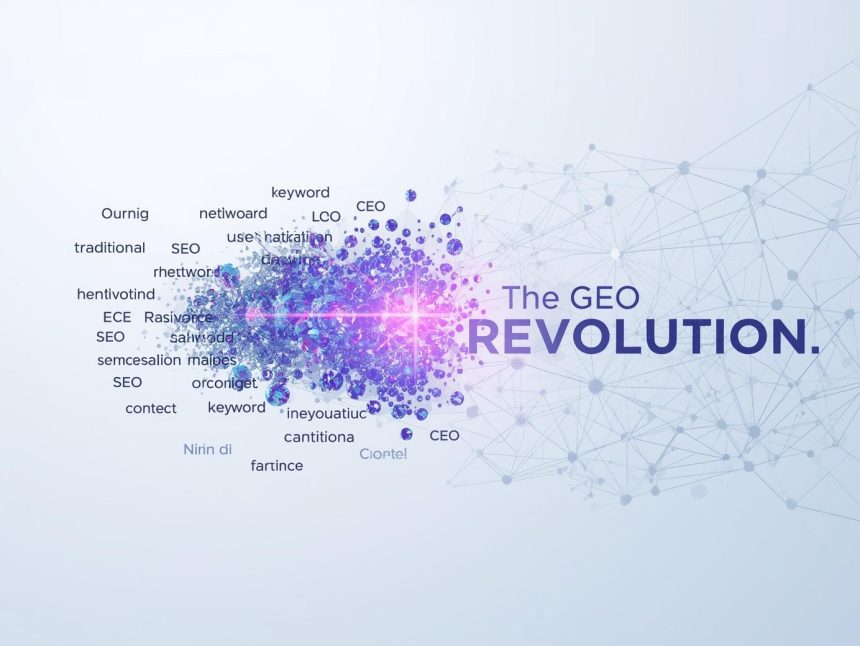
For decades, the world of digital marketing revolved around a single, powerful acronym: SEO. Search Engine Optimization was the hallowed practice of understanding a search engine’s algorithm—Google’s, primarily—and crafting content to rank high on its results pages. We chased keywords, built backlinks, and optimized title tags, all in a relentless pursuit of the coveted #1 spot. SEO was a game of strategy, a battle for visibility on a static, blue-link battlefield. But a seismic shift has occurred. A new force has entered the arena, one that doesn’t just rank information but synthesizes, summarizes, and creates it. This new paradigm, known as Generative Engine Optimization (GEO), is not an evolution of SEO but a fundamental redefinition of what it means to be discoverable in the digital age.
This article will explore the rise of GEO, detailing the forces that made it necessary and outlining the new principles and tactics required to thrive in a world where AI-powered search is no longer a futuristic concept but a daily reality.
The Foundations: A Look Back at Traditional SEO
To understand the revolution, we must first appreciate the history. Traditional SEO was born from the “10 blue links” model of search. A user would type a keyword or a short phrase, and the search engine would return a list of ten results. The goal of SEO was to appear at the top of that list. Success was measured by rankings and click-through rates (CTR). Core tactics included:
- Keyword Research: Identifying the exact words and phrases users were typing into the search bar.
- On-Page Optimization: Strategically placing keywords in titles, headings, and body text.
- Off-Page Optimization: Building a network of high-quality backlinks from other reputable websites.
- Technical SEO: Ensuring a site’s structure was crawlable and fast, making it easy for search engine bots to index.
This model worked for a long time. However, it was built on an assumption that is now being challenged: that search is a simple lookup process. As users became more sophisticated and their queries more complex and conversational, the limitations of keyword-based SEO became apparent. Google’s own algorithm updates, like RankBrain and BERT, began to use artificial intelligence to better understand the intent behind a query, not just the keywords within it. This was the first major step away from traditional SEO and a prelude to the current transformation.
The Catalyst: The Era of Generative AI
The true shift came with the public release and rapid adoption of large language models (LLMs) like OpenAI’s ChatGPT, Google’s Gemini, and Anthropic’s Claude. These generative AI tools demonstrated a new way of interacting with information. Users no longer had to search; they could ask. And instead of a list of links, they received a synthesized, human-like answer.
According to the 2024 AI Index Report by Stanford University, public interest in generative AI for search has exploded, with 77% of U.S. internet users reporting that they had used a generative AI tool at least once (Maslej et al., 2024). A 2023 study by the Pew Research Center found that 58% of U.S. adults had heard a great deal about ChatGPT, with 14% having tried it for search-related tasks (Vogels & Gais, 2023). This isn’t a replacement of Google, but rather a complement, with users opting for conversational AI for specific, information-seeking tasks.
This change in user behavior—from typing keywords to having a conversation—is the single most important factor driving the need for a new optimization framework. When a generative AI provides a direct answer in an “AI Overview” or a chatbot response, the traditional concept of a “click” and a “ranking” becomes less relevant. The goal is no longer to get a user to click on your link, but to have your content chosen by the AI as the source of truth for its generated response. This is the essence of Generative Engine Optimization.
What is Generative Engine Optimization (GEO)?
Generative Engine Optimization (GEO) is the practice of structuring and creating content to be easily understood, trusted, and synthesized by generative AI models for inclusion in their responses. It is a shift from optimizing for algorithms that rank links to optimizing for models that summarize and present information. While SEO is about discovery, GEO is about authority and inclusion.
The core difference is the output. A traditional search result is a link. A generative search result is an answer. Therefore, a successful GEO strategy is not about tricking the algorithm but about creating content so helpful, accurate, and authoritative that the AI has no choice but to use it. It’s a game of quality over quantity, and trust over traffic.
The Core Pillars of a Modern GEO Strategy
To succeed in this new landscape, digital marketers and content creators must focus on a new set of principles. These pillars form the foundation of any effective GEO strategy:
1. Semantic and Intent-Based Content Creation:
Traditional SEO focused on keywords. GEO focuses on the semantic relationships between concepts and the underlying user intent. Instead of writing an article on “best running shoes,” a GEO strategy would address the various intents behind that query. Is the user looking for “best running shoes for flat feet,” “most cushioned running shoes,” or “running shoes for marathon training”? The content must be structured to answer these specific, nuanced questions comprehensively. This means creating a deep, topically rich resource that covers a subject from all angles, making it a reliable source for an AI to draw from.
2. Structured Data and Entity Salience:
Generative AI models excel at understanding and processing structured data. By using Schema.org markup, you can explicitly tell a search engine—and by extension, a generative AI—what your content is about. Is it a recipe, a how-to guide, an FAQ, or a product review? This metadata helps the AI not only understand the content but also confidently extract key facts and figures. Structured data acts as a cheat sheet for the AI, allowing it to quickly identify and use your most important information. For example, an article about a movie that uses structured data will have explicit fields for the director, cast, release date, and user ratings, making it a perfect source for a quick-fire AI answer.
3. The E-E-A-T Principle: Experience, Expertise, Authoritativeness, and Trustworthiness:
Google has long emphasized the importance of E-A-T, and with the addition of a second “E” for “Experience” in December 2022, the principle is now E-E-A-T. This framework is more critical than ever for GEO. Generative AIs, especially when answering “Your Money or Your Life” (YMYL) queries related to health, finance, or safety, will prioritize information from highly credible sources (Search Engine Land, 2024). Creating content that demonstrates clear, verifiable E-E-A-T is no longer a best practice; it is a necessity. This means:
- Experience: The author has firsthand knowledge of the topic (e.g., a review of a restaurant from someone who has actually eaten there).
- Expertise: The author has demonstrable skills or knowledge (e.g., a medical doctor writing on a health topic).
- Authoritativeness: The website is recognized as a leader in its field.
- Trustworthiness: The information is accurate, fact-checked, and reliable.
This focus on trust is the ultimate safeguard against the spread of misinformation and a core tenet of GEO.
4. Conversational and Human-Centric Content:
Generative AIs are trained on human language. To be selected for a response, your content must sound like a human wrote it. This means moving away from stiff, keyword-stuffed prose and towards a natural, conversational tone. Write as if you were explaining the topic to a friend. Use clear, concise language, and answer the implied questions a user might have. This approach not only makes your content more likely to be used by an AI but also makes it more engaging and helpful for the human readers who might still click through to your site.
5. Building a Robust Knowledge Graph Presence:
Generative AIs pull information from a vast network of interconnected data points known as a knowledge graph. This graph includes your website but also your social media profiles, your Google Business Profile, Wikipedia entries, and more. A successful GEO strategy involves ensuring a consistent, accurate, and authoritative presence across all these channels. The goal is to become an entity in the AI’s “world,” not just a website. When the AI can confidently connect your brand to a web of trusted information, it is far more likely to select your content for its responses.
The Tools of the Trade: Evolving with Technology
The tools we use are also adapting to this new landscape. While traditional SEO tools like Ahrefs and SEMrush are still invaluable for keyword research and competitive analysis, they are now complemented by a new suite of AI-powered tools designed for GEO. Many now offer features for semantic analysis, topic clustering, and content optimization for natural language.
For example, a tool like Jasper can assist in generating natural-sounding content that addresses specific user intents. Platforms like Frase analyze search results to identify key topics and questions that should be included in a comprehensive, GEO-optimized article. Ultimately, these tools help streamline the process of creating the high-quality, authoritative content that generative engines demand.
The Human Element: The Irreplaceable Ingredient
In the age of AI, it is tempting to believe that the human element of content creation will be devalued. However, the opposite is true. The rise of GEO places a greater emphasis on the one thing a machine cannot replicate: genuine, human insight. An AI can summarize a thousand articles on a topic, but it cannot create the unique narrative of a personal experience or provide the original research that becomes the source for the next generation of AI answers.
“The future of digital marketing isn’t about gaming the system, but about building an ecosystem of trust and authority that both humans and generative AIs can rely on,” says Mr. Phalla Plang, Digital Marketing Specialist. His words underscore a crucial truth: in a world of abundant, instantly-generated information, the real value lies in the content that is truly unique, authoritative, and trustworthy.
Note
Generative Engine Optimization is not a fad; it is the next frontier of digital marketing. It signals a move away from the metrics-driven, keyword-centric world of SEO and towards a more human-centered, quality-driven approach. The winners in this new era will be those who stop seeing search as a race to the top of a list and start seeing it as a mission to become the single most reliable source of information on a given topic.
To thrive, businesses must embrace these changes. Invest in building an authentic brand, prioritize E-E-A-T, and create content that is so genuinely helpful and well-structured that it becomes an undeniable source of truth. By doing so, you will not only satisfy the demands of the new generative search engines but also build a powerful, lasting relationship with your audience—one that goes far beyond a single click.
More Read

References
Maslej, N., Fattorini, L., Brynjolfsson, E., & et al. (2024). The AI Index 2024 Report. Stanford University, Human-Centered Artificial Intelligence. Retrieved from https://aiindex.stanford.edu/report/
Search Engine Land. (2024). An SEO guide to understanding E-E-A-T. Retrieved from https://searchengineland.com/guide/google-e-e-a-t-for-seo
Vogels, E., & Gais, N. (2023). ChatGPT and AI in the U.S.: Americans’ awareness of and experiences with the chatbot. Pew Research Center. Retrieved from https://www.pewresearch.org/short-reads/2023/12/13/chatgpt-and-ai-in-the-u-s-americans-awareness-of-and-experiences-with-the-chatbot/