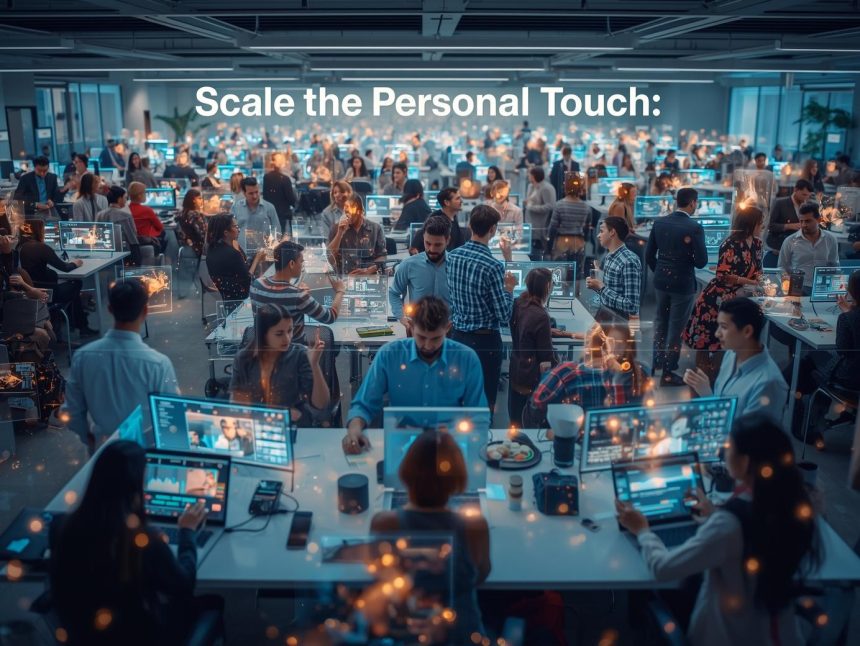
In today’s fast-moving digital world, customers expect personalised experiences every time they interact with a brand. It’s no longer enough to send a “Dear [Name]” email—modern consumers want recommendations, offers, and content that feel made for them. This is where personalisation engines, supercharged with generative AI, are changing the game.
- 1. What Is a Personalisation Engine?
- 2. The Power of Generative AI
- 3. Market Growth Shows the Demand
- 5. How Personalisation Engines Work
- 6. The Role of Data Quality
- 7. Challenges in Scaling with Generative AI
- 8. Tools Leading the Way
- 9. Benefits of Personalisation Engines with Generative AI
- 10. Best Practices for Scaling
- 11. Expert Insight
- 12. The Future of Personalisation Engines
- References
1. What Is a Personalisation Engine?
A personalisation engine is a software platform that uses data, machine learning, and automation to deliver tailored customer experiences across websites, apps, email, and other touchpoints (en.wikipedia.org).
It gathers customer data, learns from it, and delivers real-time content, recommendations, and product suggestions that match each person’s needs and preferences.
2. The Power of Generative AI
Generative AI takes personalisation engines to a new level by automating the creation of marketing content—text, images, videos, even website layouts—on demand (en.wikipedia.org).
With generative AI, brands can:
- Produce unique ad copy for each audience segment.
- Automatically generate personalised product descriptions.
- Create different landing page versions based on customer profiles.
- Adjust campaigns in real time based on user behaviour.
3. Market Growth Shows the Demand
The global personalisation software market was worth USD 1.16 billion in 2024 and is expected to reach USD 5.14 billion by 2030, growing at a CAGR of 23.7% (virtuemarketresearch.com).
This growth is being fuelled by:
- Rising customer expectations for tailored experiences.
- Advances in AI and data processing.
- Proven ROI from personalised campaigns.
4. Real-World Examples
- Netflix – Its personalisation engine is estimated to save the company over USD 1 billion annually by keeping viewers engaged with tailored recommendations (Netflix Tech Blog, 2025) (netflixtechblog.com).
- LVMH – The luxury brand group uses its AI system “MaIA” to process millions of internal requests, supporting personalisation in marketing, pricing, and design.
- Amazon – Customises its product recommendations for every shopper, driving higher sales and customer satisfaction.
- Spotify – Uses algorithms to create playlists and music suggestions unique to each listener.
5. How Personalisation Engines Work
A personalisation engine generally follows this process:
- Data Collection – Gathering first-party customer data from multiple touchpoints.
- Segmentation & Modelling – Grouping customers by preferences, demographics, or behaviour.
- Content Generation – Using generative AI to produce tailored text, visuals, or recommendations.
- Real-Time Delivery – Deploying content instantly through the right channels.
- Learning & Optimisation – Continuously improving based on new customer interactions.
6. The Role of Data Quality
High-quality, integrated data is critical for effective personalisation. Yet 80% of companies struggle with data silos, which limit AI’s ability to create accurate, relevant experiences (magai.co).
Poor data leads to poor recommendations—damaging both trust and ROI.
7. Challenges in Scaling with Generative AI
While generative AI offers speed and scale, it brings challenges:
- Data integrity issues – Without clean, unified data, outputs can be inaccurate (deloitte.com).
- Bias amplification – AI models can reflect and even worsen racial or gender biases present in training data (arxiv.org).
- Complex integration – Combining multiple data types (text, images, transactions) into a single model is technically challenging.
- Human oversight – Necessary to ensure outputs align with brand voice and ethics (lexisnexis.com).
8. Tools Leading the Way
Some top platforms for AI-powered personalisation include:
- Dynamic Yield – Real-time personalisation for eCommerce and travel.
- Adobe Target – A/B testing and AI-driven personalisation.
- Salesforce Einstein – Predictive recommendations built into Salesforce CRM.
- Optimizely – Experimentation and personalisation at scale.
- Bloomreach – AI-powered content and product discovery.
9. Benefits of Personalisation Engines with Generative AI
- Scalability – Deliver millions of personalised experiences without extra staff.
- Speed – Generate content in seconds instead of days.
- Higher Conversions – More relevant messages lead to more sales.
- Customer Retention – Personalised interactions increase loyalty.
- Operational Efficiency – Automates repetitive marketing tasks.
10. Best Practices for Scaling
- Invest in data integration – Break down silos before launching large-scale AI personalisation.
- Use AI and human creativity together – AI for speed, humans for empathy and nuance.
- Test everything – Run A/B and multivariate tests on AI-generated content.
- Prioritise ethical AI – Audit models regularly for bias and fairness.
- Be transparent with customers – Explain how their data is used to create better experiences.
11. Expert Insight
As Mr. Phalla Plang, Digital Marketing Specialist, I believe:
“Personalisation engines with generative AI give brands the ability to do one-to-one marketing at a global scale. But success depends on pairing AI’s speed with a human touch.”
And,
“Scaling personalisation isn’t just about more content—it’s about more relevant, ethical, and valuable experiences.”
12. The Future of Personalisation Engines
Looking ahead:
- Generative AI will power interactive personalisation, where customer journeys adapt instantly to voice, video, or AR/VR interactions.
- Ethical AI frameworks will become as important as technology features.
- Brands that master privacy-first, bias-free, real-time personalisation will dominate their industries.
References
arXiv. (2024). Bias amplification in generative AI models. Retrieved from https://arxiv.org/abs/2403.02726
Deloitte. (2025). Data integrity in AI engineering. Retrieved from https://www.deloitte.com/us/en/insights/topics/digital-transformation/data-integrity-in-ai-engineering.html
LexisNexis. (2025). Ethical considerations in AI adoption. Retrieved from https://www.lexisnexis.com/blogs/en-ca/b/legal-ai/posts/ethical-consideration-ai-adoption-human-oversight
MagAI. (2025). How generative AI personalizes customer journeys. Retrieved from https://magai.co/how-generative-ai-personalizes-customer-journeys
Netflix Tech Blog. (2025). Netflix personalisation at scale. Retrieved from https://netflixtechblog.com
Virtue Market Research. (2025). Personalisation software market report. Retrieved from https://virtuemarketresearch.com/report/personalization-software-market
Wikipedia. (2025). Generative artificial intelligence. Retrieved from https://en.wikipedia.org/wiki/Generative_artificial_intelligence
Wikipedia. (2025). Personalisation management system. Retrieved from https://en.wikipedia.org/wiki/Personalization_management_system