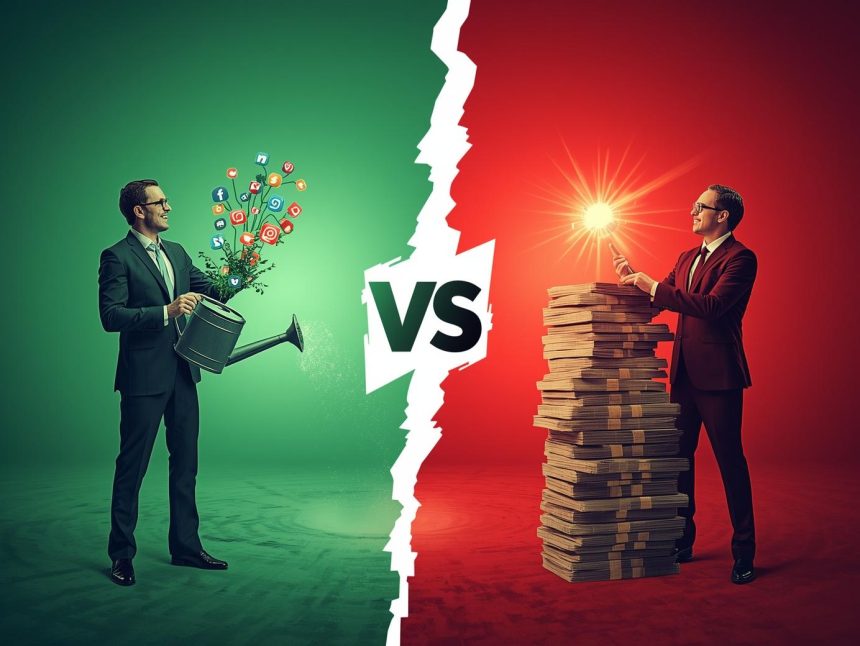
In 2025, the digital marketing world continues to evolve rapidly. Businesses of all sizes are questioning where to invest their efforts and money—organic or paid social media. With tighter budgets, increased competition, and algorithm changes, choosing the right mix has become essential. This article offers a full comparison of both strategies and helps you determine which one provides the best return on investment (ROI).
What Is Organic Social Media?
Organic social media involves unpaid content that brands publish on their social media channels to reach and engage followers. This includes posts, videos, stories, comments, and direct messages.
Benefits of Organic Social Media:
- Builds authentic brand presence and trust
- Encourages two-way communication with followers
- Helps maintain a consistent online presence over time
- Drives long-term brand loyalty
However, organic content faces increasing challenges. Meta’s average organic reach for Facebook pages dropped to 1.64% in 2024, while Instagram’s average organic reach sits at about 9.34% (Hootsuite, 2024). That means only a small portion of followers see your posts unless they’re highly engaging or shared widely.
What Is Paid Social Media?
Paid social media includes any sponsored content or advertisements that businesses pay for to reach a larger or targeted audience. This includes boosted posts, display ads, carousel ads, story ads, and video ads on platforms like Facebook, Instagram, LinkedIn, TikTok, and YouTube.
Benefits of Paid Social Media:
- Allows precise targeting based on demographics, interests, and behaviours
- Delivers faster results and visibility
- Drives traffic, leads, and conversions effectively
- Provides measurable results using ad tools and analytics
On the downside, paid ads can become expensive, especially if not optimised correctly. The average cost per click (CPC) on Facebook was $1.20 in early 2025, while LinkedIn CPC ranged between $5–$7 depending on the industry (WordStream, 2025).
Organic vs Paid: ROI Comparison in 2025
Let’s break down which strategy offers better ROI across key marketing goals.
1. Brand Awareness
- Paid Social: Offers immediate reach. For instance, boosting a high-performing Instagram post can extend its visibility to thousands within hours. Ads can also introduce your brand to new customers who’ve never heard of you.
- Organic Social: Builds awareness slowly but steadily. It’s more effective for reinforcing your brand identity through consistent posting and engagement.
Verdict: Paid wins for short-term reach; organic wins for long-term awareness.
2. Engagement and Community Building
- Organic Social: Strong in building authentic communities. You can post behind-the-scenes content, reply to comments, host live videos, and create conversations.
- Paid Social: May drive clicks and reactions, but often lacks depth in engagement quality.
Verdict: Organic wins here. People engage more meaningfully with content that feels human and authentic.
3. Lead Generation and Sales
- Paid Social: Extremely effective. With tools like Meta Pixel, Lookalike Audiences, and conversion tracking, paid ads are a go-to for generating leads and driving e-commerce sales.
- Organic Social: Can generate leads, but usually at a much slower pace and only after building strong brand trust.
Verdict: Paid wins for speed and scalability.
4. Cost Efficiency
- Organic Social: Requires time, effort, and content planning, but involves no direct payment. Over time, a solid organic strategy becomes more cost-effective.
- Paid Social: Can get expensive—especially in competitive industries or if ads are poorly optimised.
Verdict: Organic wins for sustainability, while paid can be cost-effective only if well-managed.
5. Customer Trust and Loyalty
- Organic Social: Builds brand loyalty and credibility. In fact, 92% of consumers trust user-generated content more than traditional advertising (Nielsen, 2024).
- Paid Social: Often viewed as promotional and less trustworthy unless executed with authenticity.
Verdict: Organic leads in trust and long-term loyalty.
When to Use Organic vs Paid (in Practice)
| Marketing Objective | Recommended Approach |
| New product launch | Paid + organic teaser content |
| Driving traffic to a landing page | Paid |
| Building long-term engagement | Organic |
| Running seasonal campaigns | Paid |
| Improving customer loyalty | Organic |
The Power of Combining Both: Hybrid Strategy
Rather than choosing one over the other, the smartest marketers are combining both strategies. A hybrid strategy works like this:
- Post organically to share updates, brand stories, and community content.
- Boost your best-performing posts to reach more people.
- Use paid ads for specific business goals (e.g., webinar signups or product launches).
- Retarget users who engaged organically with your paid ads.
This integrated approach delivers higher ROI over time, and allows you to build a brand while also achieving conversion-focused goals.
Real-Life Example: Glossier
Glossier, the beauty brand, is a prime example. It built a strong community via organic content, user-generated photos, and influencer shoutouts. Once the brand gained traction, it began investing in paid campaigns for product launches and sales. This mix helped the company scale while keeping its community-first brand identity intact (Rogers, 2023).
Key Tools to Track ROI for Organic and Paid
To know which strategy is really working for you, use these tools to track ROI:
- Meta Business Suite – to monitor performance of Facebook and Instagram posts and ads
- Google Analytics – to see referral traffic and goal conversions
- Sprout Social – for both organic and paid analytics
- Buffer – for content scheduling and engagement tracking
- Hootsuite – to compare channel performance across platforms
- Bitly – for tracking link clicks from organic campaigns
2025 Social Media Platform Updates That Affect ROI
- Instagram Reels and Stories are still being favoured by the algorithm, especially when paired with trending audio (Socialinsider, 2025).
- LinkedIn’s new AI tools now allow marketers to create more engaging lead-gen forms directly within paid campaigns.
- Facebook Groups offer more organic reach than regular posts, as communities get algorithmic boosts.
- TikTok’s Creator Marketplace helps brands collaborate with influencers for a balance of organic and paid exposure.
Note
If your business needs fast leads, sales, and reach, paid social will deliver better ROI—in the short term. But if your goal is brand longevity, trust, and meaningful engagement, organic social offers better ROI over time.
Ultimately, the best ROI in 2025 comes from using organic and paid together:
- Use paid to boost visibility
- Use organic to retain loyalty and build trust
- Test and optimise based on data and audience behaviour
The smartest marketers don’t choose between them—they balance both strategically.
More Read

References
Hootsuite. (2024). The Global State of Digital 2024. Retrieved from https://www.hootsuite.com/resources/digital-trends
Nielsen. (2024). Trust in Advertising 2024 Global Report. Retrieved from https://www.nielsen.com/global/en/insights
WordStream. (2025). Social Media Advertising Benchmarks for 2025. Retrieved from https://www.wordstream.com/blog/ws/2025/paid-social-benchmarks
Rogers, C. (2023). How Glossier Uses Social Media to Build Brand Loyalty. Social Media Today. Retrieved from https://www.socialmediatoday.com/news/glossier-brand-building-social-strategy
Socialinsider. (2025). Instagram Engagement Benchmarks 2025. Retrieved from https://www.socialinsider.io/blog/instagram-benchmarks/