Influencer marketing has become an essential channel for brand promotion, driving engagement, loyalty, and sales across social platforms. But as the industry matures—now worth over $24 billion in 2025 (Influencer Marketing Hub, 2025)—governments and regulators have tightened disclosure and advertising rules. Today, transparency and compliance are not just best practices—they are legal requirements.
- 1. Why Disclosure Matters More Than Ever in 2025
- 2. What Must Be Disclosed
- 3. United States: FTC Guidelines (Updated 2023–2025)
- 4. United Kingdom: ASA and CMA Requirements
- 5. European Union: Digital Services Act (DSA)
- 6. Australia: AANA Code of Ethics
- 7. Common Disclosure Mistakes to Avoid
- 8. Platform-Specific Disclosure Tools (2025 Updates)
- 9. Enforcement Trends in 2025
- 10. Best Practices for Compliance
- References
This article reviews the current state of influencer marketing regulations and disclosure laws globally, providing a clear, updated view of what brands and creators must do to remain compliant in 2025.
1. Why Disclosure Matters More Than Ever in 2025
As influencers shape consumer buying behaviour—especially among Gen Z and Millennials—authorities are increasing their focus on truth in advertising. Undisclosed sponsorships can mislead audiences, violating consumer protection laws and damaging public trust.
In 2025, failure to disclose paid partnerships can result in:
- Government fines
- Platform account suspension
- Public backlash
- Legal liability for both influencers and brands (FTC, 2023; ASA, 2025)
2. What Must Be Disclosed
Disclosure is required when:
- An influencer receives payment, free products, or services
- There is a material connection (e.g., affiliate links, gifts, commissions)
- The brand has any editorial input or approval of the content
Even without direct payment, influencers must disclose if they receive any benefit in exchange for promotion (Federal Trade Commission [FTC], 2023).
3. United States: FTC Guidelines (Updated 2023–2025)
The U.S. Federal Trade Commission (FTC) requires:
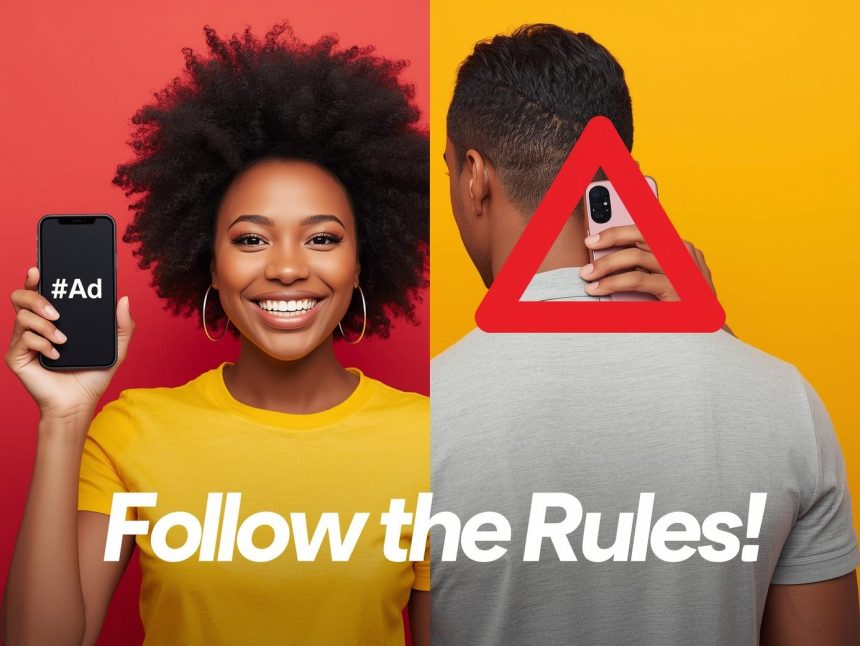
- Clear, unambiguous language such as “Ad,” “Sponsored,” or “Paid partnership with [brand]”
- Disclosure must appear at the beginning of the post or video, not buried in hashtags or descriptions
- Verbal and on-screen disclosures for video and audio content
The FTC warns that terms like “thanks [brand]” or “collab” are not sufficient. Non-compliance may lead to penalties of up to $50,000 per violation (FTC, 2023).
4. United Kingdom: ASA and CMA Requirements
The UK’s Advertising Standards Authority (ASA) and Competition and Markets Authority (CMA) enforce disclosure standards. Influencer content must be:
- Obviously identifiable as advertising
- Labelled clearly with #Ad, #Advert, or “Paid partnership with [brand]”
- Disclosed every time a product is promoted—even if previously disclosed
According to ASA (2025), ambiguous hashtags like #gifted or #spon are not enough, and both the influencer and the brand share responsibility for compliance.
5. European Union: Digital Services Act (DSA)
The Digital Services Act, enforced in 2024, impacts influencers and brands across the EU. Key requirements include:
- Transparent labelling of paid content
- Restrictions on marketing to minors
- Disclosure of AI-generated content or endorsements
Brands and platforms are now held liable for ensuring influencers comply with these rules (Statista, 2025).
6. Australia: AANA Code of Ethics
The Australian Association of National Advertisers (AANA) mandates that influencer content must be:
- Clearly distinguishable from organic content
- Disclosed using terms like #Ad, #PaidPromotion, or “Sponsored”
- Supported by written agreements outlining disclosure obligations
AANA (2024) states that brand partners are equally liable if influencers fail to follow the code.
7. Common Disclosure Mistakes to Avoid
In 2025, many enforcement actions stem from simple errors. Avoid:
- Hiding disclosures in the middle or end of captions
- Using ambiguous hashtags like #partner or #thanks
- Failing to disclose gifted products
- Relying solely on platform tools without additional disclosures
Shopify (2024) found that 42% of eCommerce brands faced legal risks due to influencer disclosure violations in the previous year.
8. Platform-Specific Disclosure Tools (2025 Updates)
Most platforms now provide built-in options for proper disclosure:
| Platform | Disclosure Feature |
| “Paid Partnership with” tag above posts | |
| TikTok | Branded content toggle in Creator Tools |
| YouTube | “Includes paid promotion” checkbox |
| Brand Collabs Manager | |
| Manual caption disclosure required |
Note: These tools support compliance, but influencers must also include written or spoken disclosures, especially in video content (ASA, 2025).
9. Enforcement Trends in 2025
According to Influencer Marketing Hub (2025):
- 28% increase in influencer disclosure violations from 2023 to 2024
- Over $3 million in collective fines issued in the U.S. and U.K.
- AI monitoring tools now scan posts automatically for non-compliant content (ASA, 2025)
Regulators are using machine learning algorithms to track social content in real-time, flagging violations at scale.
10. Best Practices for Compliance
Brands and creators should adopt these steps to ensure transparency:
- Always use #Ad, “Sponsored by,” or similar clear phrases
- Place disclosures at the start of posts and include them in video and audio
- Disclose every time a product or service is promoted, even across platforms
- Include disclosure terms in influencer contracts
- Review all influencer content before and after posting
Use tools like HypeAuditor or Tagger to audit influencer content and track compliance in real-time.
Note
In 2025, clear disclosure is more than a regulatory obligation—it’s a way to build brand integrity and consumer trust. With laws becoming stricter and enforcement increasing, brands must prioritise education, contracts, platform tools, and real-time monitoring to ensure full compliance.
By putting disclosure front and center, brands and influencers not only avoid legal trouble—they strengthen their reputation in a competitive digital landscape.
More Read

References
AANA. (2024). AANA Code of Ethics & Guidelines for Influencer Marketing. https://aana.com.au/
ASA. (2025). Influencer Ad Disclosure Compliance Report. https://www.asa.org.uk/
Federal Trade Commission. (2023). Disclosures 101 for Social Media Influencers. https://www.ftc.gov/business-guidance/resources/disclosures-101-social-media-influencers
Influencer Marketing Hub. (2025). Influencer Marketing Benchmark Report 2025. https://influencermarketinghub.com/influencer-marketing-benchmark-report/
Shopify. (2024). Legal Risks in Influencer Marketing for eCommerce. https://www.shopify.com/blog/influencer-compliance
Statista. (2025). Regulatory Developments in Social Media Advertising. https://www.statista.com/