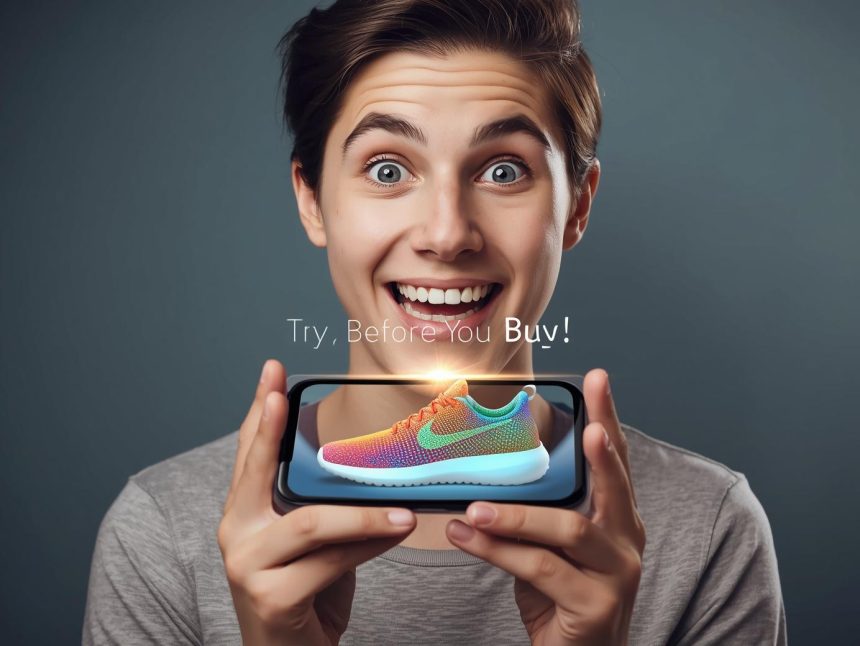
Imagine browsing an online store, pointing your smartphone at your living room, and instantly visualizing how a new sofa will fit. Or using your phone’s camera to virtually try on a lipstick shade before deciding whether it suits your skin tone. These experiences are not futuristic dreams—they are the reality of augmented reality (AR) shopping and virtual try-on, which are transforming how brands and customers interact.
“We must let consumers see before they buy; AR gives them that power,” says Mr. Phalla Plang, Digital Marketing Specialist.
This article explores how AR shopping and virtual try-on are reshaping digital marketing and e-commerce in 2025. You will learn why brands are investing in AR, which technologies drive adoption, case studies of success, key strategies for marketers, and how to measure ROI effectively.
Why AR Shopping Matters More Than Ever
Reducing Purchase Uncertainty
One of the greatest challenges of e-commerce is uncertainty—customers can’t physically touch or try products. AR bridges this gap by showing products in context. According to Google, AR shopping features increase buyer confidence and drive higher purchase intent (Think with Google, n.d.).
For example, a shopper can project a new dining table into their kitchen through AR to confirm size, color, and style. This helps reduce return rates, a significant cost for online retailers.
Driving Engagement and Sharing
AR is inherently interactive and social. Many users take screenshots or record videos while trying AR filters and share them online, creating free word-of-mouth marketing. This builds brand loyalty and boosts organic reach across platforms like Instagram, TikTok, and Snapchat.
Differentiating in a Crowded Market
In competitive industries, AR provides an innovation edge. As Forbes (2024) highlights, immersive media—including AR, AI, and video—are among the top forces shaping digital marketing strategies. Brands using AR demonstrate modernity and a commitment to customer experience, which strengthens positioning.
Boosting Conversions and Sales
Data suggests that AR directly impacts conversions. Makarov (2025) reports that retailers implementing AR tools see measurable sales uplift, especially in high-consideration product categories like fashion, cosmetics, and furniture. By enabling customers to “try before they buy,” AR shortens the decision-making journey.
How AR Shopping Works: Apps, SDKs, and WebAR
Implementing AR shopping involves two main approaches: native applications (using SDKs such as ARKit or ARCore) or browser-based AR experiences, known as WebAR.
| Approach | Pros | Cons | Best Use Cases |
| Native Apps (e.g., ARKit, ARCore) | Advanced features, smoother rendering, offline use | Requires app download, higher cost, user friction | Established brands with existing mobile apps |
| WebAR (browser-based AR) | No app required, instant access via link or QR code, easier analytics | Limited performance, browser compatibility issues | Campaigns, e-commerce product pages, mass reach |
WebAR is particularly promising for e-commerce because it lowers barriers for users. Instead of downloading an app, shoppers simply click a link on a product page to view it in their environment (Wikipedia, n.d.).
Tools and Frameworks
Several tools enable AR shopping experiences:
- 8th Wall (Niantic) — leading WebAR platform
- Wikitude and Vuforia — robust AR SDKs for apps
- Spark AR and Lens Studio — AR creation tools for social media
- AR.js and Three.js — open-source frameworks for lightweight WebAR
The choice depends on budget, target audience, and product complexity.
Case Studies: AR Shopping in Action
IKEA Place
IKEA’s Place app allows customers to virtually place furniture in their homes at true scale. This solves a key pain point—visualizing how a large product will fit before purchase. The app has been widely credited with reducing customer hesitation (HQSoftware, 2025).
Sephora Virtual Artist
Sephora’s AR try-on tool lets shoppers test lipsticks, eyeshadow, and other cosmetics through their phones. By addressing uncertainty about color matching, the brand increased digital engagement and boosted online sales (HQSoftware, 2025).
Google AR Beauty Try-On
Google has integrated AR try-on directly into mobile search. Users can preview products from brands like MAC and L’Oréal without leaving search results. This seamless integration improves discoverability and shortens the path to purchase (Vogue Business, 2023).
Retail AR Mirrors
Luxury eyewear and fashion brands are experimenting with AR mirrors in physical stores. Customers can virtually “try” multiple products without physically changing. This enhances the in-store experience while connecting to digital commerce.
These examples show that AR is not just a novelty—it directly addresses business goals such as sales conversion, brand engagement, and reduced returns.
Strategy: Building an AR Shopping Initiative
For brands looking to adopt AR shopping, here’s a practical roadmap:
1. Identify High-Impact Products
Focus on products where visualization drives purchase confidence—furniture, fashion, cosmetics, eyewear, or décor.
2. Select the Right Platform
If your brand has a widely used mobile app, integrating AR via SDK makes sense. For wider reach, WebAR is ideal. For engagement campaigns, AR social filters can complement shopping features.
3. Create High-Quality 3D Assets
Product models should be photorealistic and scaled accurately. Techniques include 3D scanning and photogrammetry. Asset quality has a direct impact on customer experience.
4. Integrate Analytics
Track key metrics such as:
- AR impressions
- Engagement/dwell time
- Click-throughs to product pages
- Conversion rates of AR vs non-AR users
- Return rate differences
5. Test, Learn, and Iterate
Experiment with different product categories and campaigns. Compare performance of AR vs non-AR experiences to validate ROI.
6. Educate Customers
Some users may be unfamiliar with AR. Provide clear calls-to-action like “Try it in your space” or “See it on you.” Short video demos help increase adoption.
7. Scale Across Channels
Integrate AR not only into e-commerce but also into physical retail, catalogs, and advertising. QR codes in stores or print ads can link directly to AR try-on experiences.
Measuring Success: KPIs and ROI
Measuring the impact of AR is essential for proving value. Recommended KPIs include:
- AR Reach/Impressions – how many users accessed the AR feature.
- Engagement Metrics – dwell time, number of interactions.
- Conversion Rate Lift – comparison of AR users vs non-AR users.
- Average Order Value (AOV) – AR users often spend more per transaction.
- Return Rates – lower returns indicate stronger purchase confidence.
- Revenue Uplift vs. AR Investment – final ROI calculation.
For example, if an AR try-on feature increases conversion by 20% and reduces returns by 10%, the business impact is significant.
Challenges and How to Overcome Them
While promising, AR shopping has challenges:
- Device Limitations: Not all smartphones handle AR well. Solution: offer fallback 3D viewers.
- Asset Creation Costs: High-quality 3D models can be expensive. Solution: start with priority SKUs.
- User Education: Some consumers need guidance. Solution: provide onboarding overlays.
- Privacy Concerns: AR uses cameras and sensors. Solution: be transparent about permissions and data (Wood, 2023).
- Ongoing Maintenance: AR platforms must be updated regularly to stay compatible with devices and browsers.
The Future of AR Shopping
Looking ahead, several trends will shape AR shopping:
- Photorealistic rendering with improved lighting and occlusion for lifelike previews.
- AI + AR integration, enabling personalized product recommendations during try-on.
- Search engine integration, with AR results embedded directly in search (Vogue Business, 2023).
- Social commerce AR, where users try and buy products directly within apps like TikTok or Instagram.
- Standardized AR analytics, making ROI measurement more consistent across platforms.
Note
AR shopping and virtual try-on are no longer optional—they are becoming essential tools for digital marketers. They reduce uncertainty, improve customer confidence, and directly boost conversions. For brands, this is not just about adopting a technology—it’s about reimagining customer experience.
“We must let consumers see before they buy; AR gives them that power,” emphasizes Mr. Phalla Plang, Digital Marketing Specialist.
As AR becomes more accessible and integrated into everyday shopping, the brands that invest today will be tomorrow’s leaders in digital commerce.
More Read

References
Forbes. (2024, November 13). Digital marketing trends for 2025 and beyond. Forbes Business Council. https://www.forbes.com/councils/forbesbusinesscouncil/2024/11/13/digital-marketing-trends-for-2025-and-beyond/
HQSoftware. (2025, August 27). Top 7 examples of augmented reality marketing campaigns. HQSoftware. https://hqsoftwarelab.com/blog/top-7-examples-of-augmented-reality-marketing-campaigns/
Makarov, A. (2025). 12 augmented reality technology trends to watch in 2025. MobiDev. https://mobidev.biz/blog/augmented-reality-trends-future-ar-technologies
Think with Google. (n.d.). Augmented reality shopping: Insights & data. Think with Google. https://www.thinkwithgoogle.com/consumer-insights/consumer-trends/trending-visual-stories/augmented-reality-shopping-data/
Vogue Business. (2023, December 12). Google bets big on AR beauty. Vogue Business. https://www.voguebusiness.com/technology/google-bets-big-on-ar-beauty
Wikipedia. (n.d.). WebAR. In Wikipedia. https://en.wikipedia.org/wiki/WebAR
Wood, N. J. (2023). Ethical considerations of AR applications in smartphones: A systematic literature review of consumer perspectives. arXiv. https://arxiv.org/abs/2306.07288