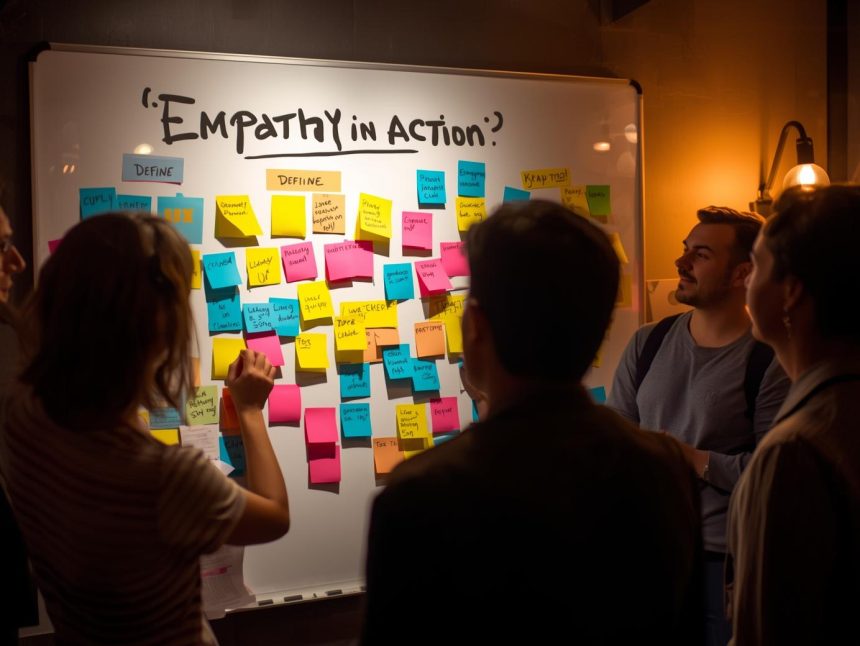
In today’s fast-changing world, building products and services that truly solve people’s problems is more important than ever. This is where design thinking comes in. It’s not just about making things look attractive—it’s about solving real human problems by understanding what users feel, want, and need. At the heart of design thinking is empathy: the ability to deeply understand and connect with users.
This article explores how design thinking works, why empathy is the foundation of it, and how businesses, governments, and nonprofits use it to create better products and services. It also includes practical tools and real examples that show design thinking in action.
What is Design Thinking?
Design thinking is a human-centered process used to solve complex problems by focusing on user needs. According to the Hasso Plattner Institute of Design at Stanford University (d.school), the process follows five main steps:
- Empathize – Learn about your users and their needs.
- Define – Clarify the problem you are solving.
- Ideate – Generate a wide range of possible solutions.
- Prototype – Create simple models or mockups.
- Test – Try the solutions with users and learn from feedback.
This iterative cycle puts the user experience at the center of every step (Stanford d.school, n.d.).
Tim Brown, Chair of IDEO, describes design thinking as “a human-centered approach to innovation that draws from the designer’s toolkit to integrate the needs of people, the possibilities of technology, and the requirements for business success” (Brown, 2009).
Why Empathy is the Starting Point
The first stage of design thinking—empathize—is where everything begins. This step means understanding your users deeply by observing how they behave, listening to their stories, and identifying their pain points.
Rather than making assumptions or only relying on data, empathy allows designers and decision-makers to learn what truly matters to users. Research shows that empathy-driven design leads to stronger engagement, better solutions, and fewer redesigns (IDEO, 2023).
Case Study: Airbnb
In 2009, Airbnb was struggling. Bookings were low, and growth was flat. Instead of focusing only on technology, the founders visited their users—Airbnb hosts—to find out what was wrong.
They discovered that most hosts had poor-quality photos, which made listings unattractive. Instead of fixing it with code, they took professional photos of the listings themselves. This small but empathetic act dramatically increased bookings and helped the company survive (Gansky, 2010).
This success came not from a technical upgrade, but from listening and observing—true empathy in action.
Case Study: IBM’s Design-Driven Culture
In 2013, IBM launched Enterprise Design Thinking, aiming to train over 100,000 employees in the design thinking process. They encouraged teams to hold user interviews, build low-fidelity prototypes, and iterate continuously.
By doing this, IBM saw measurable results:
- Products were released up to 75% faster
- User satisfaction improved by over 20%
- Costly redesigns were significantly reduced (IBM, 2020)
IBM’s approach shows how empathy and fast feedback loops can work at scale.
IBM’s Enterprise Design Thinking
Case Study: Government and Voting Design
The Center for Civic Design worked with local U.S. governments to improve the voter experience. Their team observed polling stations, interviewed voters, and analyzed ballots. They found that confusing layouts and poor signage led to mistakes.
They redesigned ballots with simpler language, clearer instructions, and better layouts. The result was fewer voter errors and improved trust in the system (Center for Civic Design, 2016).
Empathy here helped ensure more citizens could successfully cast their vote—a deeply human-centered impact.
Tools That Help Empathize with Users
Several tools can help teams understand users better during the empathy stage:
1. Empathy Maps
An empathy map shows what a user thinks, feels, says, and does during an experience. This helps uncover emotional needs that aren’t always obvious in surveys.
Try this free Empathy Map Tool from Miro.
2. User Journey Mapping
A user journey map visualizes each step the user takes, from discovering a product to using it. It identifies points of friction and highlights opportunities to improve.
Try this simple Journey Map template from Canvanizer.
3. User Interviews and Observations
Direct conversations and watching users in real time provide powerful insights. Even short interviews with 5 users can reveal up to 85% of usability issues (Nielsen Norman Group, 2012).
Tools like Lookback or Hotjar make it easy to record real user sessions.
How to Use Design Thinking in Your Own Work
You don’t need to be a designer to apply design thinking. Here’s how to get started:
Step 1: Talk to Real Users
Interview at least five people who use your product or service. Ask open-ended questions like:
- “Tell me about the last time you used this.”
- “What frustrated you?”
- “What would make this easier?”
Avoid leading questions. Just listen.
Step 2: Define the Real Problem
Turn your findings into a clear, user-centered problem statement.
Bad: “We need to upgrade our website.”
Better: “Busy users can’t find key information quickly on our site.”
Step 3: Brainstorm Wild Ideas
Gather your team and generate ideas without judgment. Aim for quantity over quality at this stage.
Use tools like FigJam or Mural to collaborate online.
Step 4: Build Low-Fidelity Prototypes
Start simple. Use paper sketches, slides, or basic mockups to bring your ideas to life.
Tools:
Step 5: Test with Users
Let users try your prototype and give feedback. Watch their expressions and actions. Learn what works—and what doesn’t.
Revise and repeat. Testing early saves time and money later.
Common Mistakes in Design Thinking
Even with the best intentions, teams can make mistakes such as:
- Skipping the empathy phase
- Testing too late
- Ignoring negative feedback
- Building based on assumptions
To avoid this, always start with real users—and stay close to them throughout the process.
Why Design Thinking Matters in Business
A 2020 report by McKinsey & Company found that design-led companies outperformed their peers by 2:1 in revenue growth (McKinsey & Company, 2020). These companies embraced user testing, cross-functional teamwork, and iterative design.
Design thinking is not just for tech or design teams. It improves services, internal processes, marketing, and even leadership decisions.
Note
Design thinking is more than a method. It’s a mindset—one that values curiosity, empathy, and experimentation. Whether you’re building an app, improving customer support, or redesigning a public service, the design thinking process helps you stay focused on what really matters: the human experience.
Empathy is not a “soft skill.” It is a competitive advantage.
By listening, observing, and learning from real users, we can create smarter solutions, reduce risks, and build products and services that truly make life better.
More Read

References
Brown, T. (2009). Change by design: How design thinking creates new alternatives for business and society. Harvard Business Press.
Center for Civic Design. (2016). Field guides to ensuring voter intent. https://civicdesign.org/field-guides/
Gansky, L. (2010). The mesh: Why the future of business is sharing. Portfolio Hardcover.
IBM. (2020). Enterprise design thinking. https://www.ibm.com/design/thinking/
IDEO. (2023). Design thinking resources. https://designthinking.ideo.com/
McKinsey & Company. (2020). The business value of design. https://www.mckinsey.com/business-functions/mckinsey-design/our-insights/the-business-value-of-design
Nielsen Norman Group. (2012). Why you only need to test with 5 users. https://www.nngroup.com/articles/why-you-only-need-to-test-with-5-users/
Stanford d.school. (n.d.). Design thinking bootleg. https://dschool.stanford.edu/resources/design-thinking-bootleg