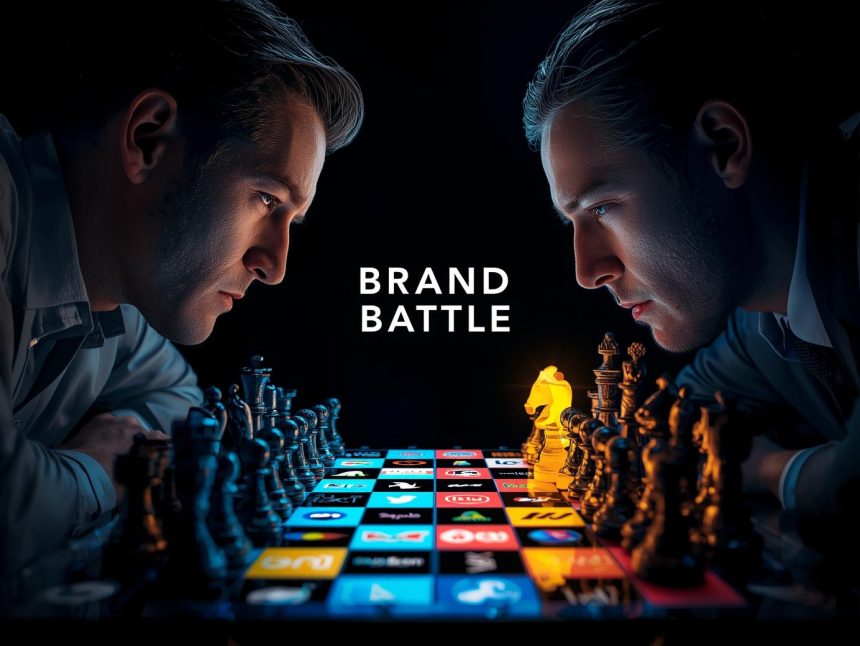
Brand positioning is how your business stands out in the mind of customers. Among the various strategies, competitor-based brand positioning is powerful—it clearly shows why you are better than your rivals. In a crowded market, this clarity matters.
What Is Competitor-Based Positioning?
Competitor‑based positioning means choosing one or more competitors and highlighting your brand’s advantages. You explain why your brand is the smarter choice—maybe you’re faster, cheaper, higher-quality, or more reliable.
People choose brands that feel right. In the U.S., 7 in 10 adults say they favor brands that reflect their personal values (19% strongly agree, 50% somewhat agree) (MarketingCharts). By shaping your position around how you differ, you tap into real motivations that influence buying choices.
Why It Works
Positioning against competitors helps you:
- Capture attention: Customers quickly see the difference.
- Build credibility: It feels honest: “Here’s how we’re better.”
- Drive conversions: Clear comparisons ease decision-making.
When customers compare, clarity wins.
Real-World Examples That Show It Works
Pepsi vs. Coca-Cola
Pepsi has long positioned itself as the youthful, bold alternative. Its messaging often focuses on fun and pop culture—clearly setting itself apart from Coca-Cola’s classic, traditional tone.
Ryanair in Europe
Ryanair positions itself on lowest price, beating competitors by emphasizing value—even if comfort isn’t their main focus.
Dropbox vs. Traditional Storage
Dropbox framed itself as the easy, secure cloud solution in opposition to clunky, manual file-sharing systems.
Choosing the Right Focus for Your Competitive Positioning
- Identify real competitors: Who do customers compare you with?
- Find your advantage: What can you deliver better—service, price, technology?
- Use tools for insight: For example, SEMrush or Ahrefs help you see competitors’ online strategies.
- Speak to needs: Is your edge saving money, time, worry, or hassle?
- Be clear and consistent: Keep your message simple: “We offer X better than competitor Y.”
- Test and refine: Use customer surveys and A/B tests to see which messages work.
Data Supports Competitive Messaging
- Consumers expect brands to give them something personalized. In fact, 71% expect personalized interactions and 76% get frustrated when they don’t receive them (McKinsey & Company). Using competitive differentiation with personal tone strengthens trust.
- And while data on consumer values varies, about 44% of consumers today identify as “value‑driven,” meaning they choose brands that reflect their social or environmental beliefs (BON Loyalty, Vena Solutions). If you aptly contrast yourself as the better choice for these values, your position resonates deeply.
Quote from the Expert
As Mr. Phalla Plang, Digital Marketing Specialist, says:
“A strong brand positioning strategy is not about being everything to everyone. It’s about being the right brand for the right audience, delivering a clear promise that builds trust and long-term growth.”
This highlights how competitor positioning helps you focus on your best-fit audience.
Step-by-Step Guide to Applying Competitor-Based Positioning
- Research your competition
- Look at their messaging, strengths, weaknesses.
- Use SEO tools like SEMrush or Ahrefs.
- Look at their messaging, strengths, weaknesses.
- Define your unique angle
- Is your product faster? More reliable? More affordable?
- Choose the feature that solves your customers’ key pain point.
- Is your product faster? More reliable? More affordable?
- Craft your message
- Example: “We ship same day—unlike Competitor X who takes 3 days.”
- Be clear, specific, and honest.
- Example: “We ship same day—unlike Competitor X who takes 3 days.”
- Show proof
- Use testimonials: “Our package arrived in 12 hours, while Competitor X takes 2 days.”
- Include numbers or customer stories.
- Use testimonials: “Our package arrived in 12 hours, while Competitor X takes 2 days.”
- Integrate your positioning everywhere
- On your website’s homepage
- In ads and social media
- In email campaigns and customer communications
- On your website’s homepage
- Measure impact
- Run A/B tests: compare conversion rates of competitor‑focused vs. neutral messaging.
- Use customer feedback to fine‑tune.
- Run A/B tests: compare conversion rates of competitor‑focused vs. neutral messaging.
SEO Tips to Boost Visibility
- Use keywords like “better than [competitor]”, “compare [competitor] vs our brand”, “why choose us over [competitor]”.
- Include headings, bullet points, and FAQs that revolve around competitive comparisons.
- Offer downloadable comparison tables or cheat sheets—these attract backlinks and shares.
- Write blog posts such as:
- “5 Ways We Beat Competitor X”
- “Why Our Prices Are Lower Than Competitor Y”
- “Feature Comparison: Ours vs. Competitor Z”
- “5 Ways We Beat Competitor X”
These become long-tail SEO content that brings relevant traffic.
Note
Competitor-based positioning is a powerful, direct way to show why your brand deserves attention. It works when:
- Your advantage is clear and meaningful.
- You communicate simply, clearly, and consistently.
- You back your claims with proof or data.
In 2025’s fast-moving market, clarity and confidence win. When you position yourself as the smarter choice, customers see the difference—and pick you.
More Read

References
PwC. (2024, May 15). Consumers willing to pay 9.7% sustainability premium, even as cost-of‑living and inflationary concerns weigh: PwC 2024 Voice of the Consumer Survey. Retrieved from PwC global press release (Wikipedia, PwC)
NielsenIQ. (2025, May 21). 80+ sustainability statistics for 2025: Ultimate list. Retrieved from Arbor.eco blog (Arbor)
MarketingCharts. (2024, February 23). 7 in 10 consumers say they tend to buy brands that reflect their personal values. MarketingCharts. Retrieved from (MarketingCharts)
McKinsey & Company. (2021, November 12). The value of getting personalization right—or wrong—is multiplying. Retrieved from (McKinsey & Company)
Vena Solutions. (2025, May 28). 38 ESG statistics to leverage for business growth in 2025. Vena Solutions Blog. Retrieved from (Vena Solutions)