Artificial intelligence (AI) is no longer just a buzzword in retail—it has become the backbone of modern shop engagement strategies. From predictive analytics that forecast shopping trends to AI-powered chatbots that provide personalized customer service, retailers worldwide are turning to intelligent technologies to transform how they connect with customers. As digital-first shopping continues to merge with physical store experiences, AI offers the tools needed to drive loyalty, optimize operations, and deliver highly engaging shopping experiences.
This article explores the most impactful AI techniques in retail and shop engagement, with a focus on practical applications, success stories, and tools that businesses can adopt to remain competitive in 2025 and beyond.
The Rise of AI in Retail
Global retail companies that integrate AI into their business models can improve profits by up to 60% through cost savings, demand forecasting, and personalization (McKinsey & Company, 2023). Gartner (2023) also predicts that by 2026, 80% of retailers will adopt AI-driven automation to enhance customer engagement. These statistics highlight a fundamental truth: AI is not optional—it is essential for staying relevant in a rapidly evolving retail landscape.
Shop engagement has always been about understanding customers, building trust, and creating memorable experiences. AI simply amplifies these goals by using data-driven insights and intelligent automation to anticipate customer needs before they even arise.
Key AI Techniques Driving Retail Engagement
1. Predictive Analytics for Demand Forecasting
Predictive analytics enables retailers to anticipate what customers will buy, when they will buy, and how much they will spend. By analyzing historical data, weather patterns, holidays, and even social media trends, AI models forecast demand with remarkable accuracy. This reduces overstocking and understocking, which costs retailers billions annually.
For example, Walmart uses AI-based forecasting to adjust supply chain strategies and respond to changing consumer preferences in real time (Forbes, 2023).
Tools to explore:
2. AI-Powered Personalization Engines
Personalization has become a defining factor in retail engagement. AI personalization engines analyze customer browsing behavior, purchase history, and demographic data to recommend products that match individual preferences.
Netflix and Amazon pioneered personalization, but retail brands like Sephora and Nike are using it to recommend beauty products or sneakers tailored to individual style and past purchases.
Tools to explore:
Key takeaway: Personalized recommendations can increase conversion rates by up to 300% (Accenture, 2022).
3. AI Chatbots and Virtual Assistants
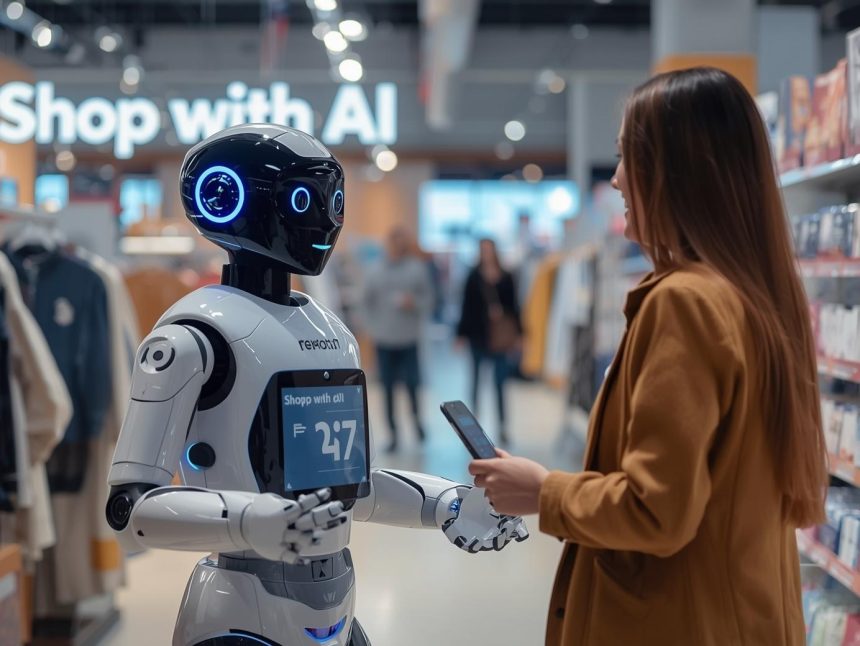
AI-driven chatbots are no longer robotic Q&A machines. With natural language processing (NLP), they provide real-time, human-like conversations that answer questions, assist in product selection, and resolve complaints instantly. This reduces wait times and improves customer satisfaction.
For example, H&M’s chatbot guides customers to outfits based on style preferences, while Macy’s AI assistant answers in-store shoppers’ questions about inventory and promotions.
Tools to explore:
4. Computer Vision for Smart Stores
Computer vision uses AI-powered cameras and sensors to recognize products, customer movements, and even emotions. This enables checkout-free stores, automated inventory management, and personalized in-store ads.
Amazon’s Just Walk Out technology is a prime example, allowing customers to grab items and leave without stopping at a checkout counter. The system charges their account automatically using AI-powered vision tracking.
Tools to explore:
5. Sentiment Analysis for Customer Insights
Retailers now use AI to scan customer reviews, feedback, and social media posts to understand sentiment toward their brand. This helps identify issues early, measure satisfaction, and improve engagement strategies.
For instance, Starbucks leverages sentiment analysis to refine product launches and digital campaigns by monitoring customer conversations online (Harvard Business Review, 2022).
Tools to explore:
6. Augmented Reality (AR) Shopping Experiences
AR powered by AI lets customers “try before they buy.” From virtual fitting rooms in fashion to 3D furniture visualization in home décor, AR creates immersive engagement that builds confidence in purchases.
IKEA Place, for example, allows shoppers to visualize how furniture will look in their homes using their smartphones.
Tools to explore:
7. Dynamic Pricing Models
AI can adjust prices in real time based on demand, competitor pricing, customer behavior, and market conditions. Airlines and ride-hailing services already use this model, but retail brands are adopting it to remain competitive without losing profitability.
Dynamic pricing strategies can increase margins by 10–25% when implemented effectively (PwC, 2023).
Tools to explore:
8. Customer Lifetime Value (CLV) Prediction
AI helps retailers calculate which customers are most valuable in the long term. By predicting lifetime value, brands can allocate resources toward high-value shoppers, offering loyalty programs, exclusive discounts, or personalized campaigns.
Key takeaway: Businesses that prioritize CLV over single transactions see long-term profitability increase by 20–30% (Harvard Business Review, 2022).
Real-World Success Stories
- Sephora uses AI chatbots and recommendation engines to create hyper-personalized experiences, increasing conversion rates from its mobile app.
- Nike leverages predictive analytics and personalization to offer product recommendations that align with customer preferences, driving repeat purchases.
- Carrefour uses AI demand forecasting to reduce food waste by accurately predicting fresh product demand.
- Starbucks applies AI through its “Deep Brew” system, which personalizes offers based on purchase history and store location.
Benefits of AI in Retail Engagement
- Improved Customer Experience: AI anticipates customer needs, ensuring smoother shopping journeys.
- Increased Efficiency: Automation reduces labor costs and improves supply chain accuracy.
- Data-Driven Decision-Making: Insights from AI guide product launches, pricing strategies, and promotions.
- Boosted Sales and Loyalty: Personalized offers and AR experiences drive higher conversions and repeat business.
As Mr. Phalla Plang, Digital Marketing Specialist, notes:
“AI in retail is not just about technology; it’s about creating meaningful connections with customers. When used wisely, AI turns data into experiences that build loyalty and trust.”
Challenges Retailers Must Address
While the benefits are clear, implementing AI in retail comes with challenges:
- High Initial Investment: Advanced AI systems can be costly for smaller retailers.
- Data Privacy Concerns: Customers are wary about how their data is collected and used.
- Skill Gaps: Many retail employees lack AI expertise, requiring training and adaptation.
- Integration Issues: AI tools must work seamlessly with existing point-of-sale and CRM systems.
The Future of AI in Shop Engagement
Looking ahead, AI in retail will likely expand in three areas:
- Hyper-Personalized Marketing: Campaigns that adapt in real time based on customer context.
- AI-Enhanced Sustainability: Optimized supply chains to minimize waste and carbon footprints.
- Phygital Shopping: Blending physical and digital shopping through AR, VR, and smart devices.
By 2030, AI in retail is projected to generate over $40 billion in value annually (Statista, 2024). This means retailers who fail to embrace AI risk being left behind in a highly competitive market.
Note
AI techniques in retail and shop engagement are transforming the way customers interact with brands, whether online or in-store. From predictive analytics and personalization engines to chatbots, AR, and computer vision, these innovations are not just improving sales—they are redefining customer relationships.
Retailers who embrace AI today position themselves for long-term success. The future of shop engagement is intelligent, personalized, and customer-first, and AI is the engine driving that transformation.
More Read

References
Accenture. (2022). Personalization pulse check: Retail trends. Accenture. https://www.accenture.com/us-en/insights/interactive/personalization-pulse-check
Forbes. (2023). Walmart’s AI strategy and retail transformation. Forbes. https://www.forbes.com/sites/forbestechcouncil/2023/05/15/walmarts-ai-strategy-and-retail-transformation
Gartner. (2023). AI adoption trends in retail. Gartner. https://www.gartner.com/en/newsroom/press-releases/2023
Harvard Business Review. (2022). Customer lifetime value and profitability. Harvard Business Publishing. https://hbr.org/2022/03/customer-lifetime-value
McKinsey & Company. (2023). The state of AI in retail 2023. McKinsey & Company. https://www.mckinsey.com/industries/retail/our-insights/state-of-ai-in-retail
PwC. (2023). Dynamic pricing strategies for retailers. PwC. https://www.pwc.com/gx/en/industries/retail-consumer/publications/dynamic-pricing.html
Statista. (2024). Artificial intelligence in retail market size worldwide from 2020 to 2030. Statista. https://www.statista.com/statistics/1097502/ai-in-retail-market-size-worldwide