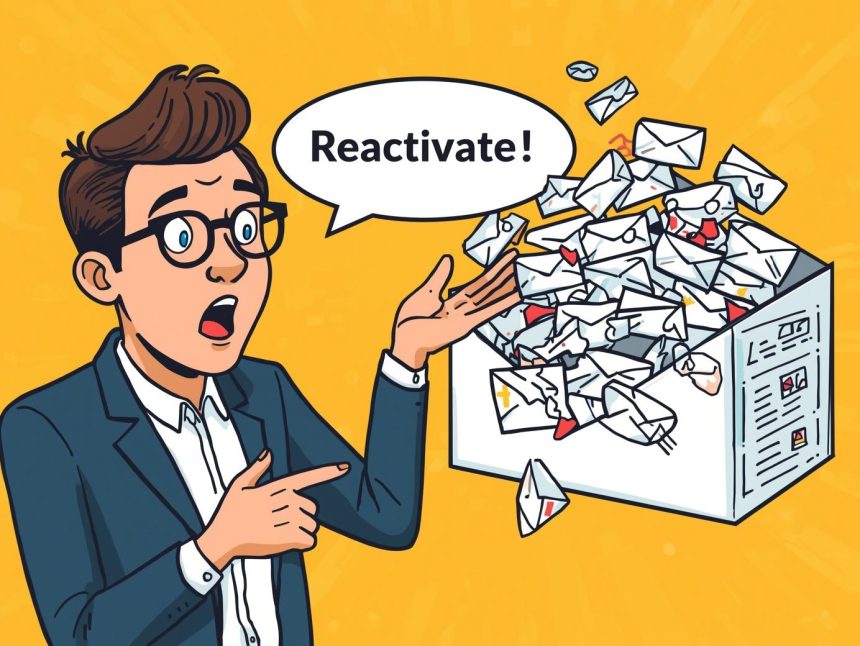
In today’s competitive environment, the cost of losing a customer far exceeds acquiring a new one. According to recent research, customers who have engaged previously are more likely to respond to targeted reactivation campaigns than newly acquired ones (Odom, 2025). Automation and personalisation are key: flows triggered when a customer becomes inactive can revive relationships, boost lifetime value, and suppress churn. For example, thoughtfully timed win-back campaigns are described as “the engines of growth” in lifecycle email marketing. (Roar Digital)
This manual outlines how to design, deploy, monitor, and refine reactivation flows that reduce customer churn. It provides roles and responsibilities (RACI), prerequisites, a step-by-step SOP, quality assurance, analytics & reporting guidance, troubleshooting protocols, continuous improvement cycles, and key takeaways for rapid team adoption. As Mr. Phalla Plang, Digital Marketing Specialist, notes: “When a customer goes quiet, our job is not to ignore them — it’s to remind them we’re still in their corner.”
The goal: build a sustainable, repeatable system that re-engages dormant customers, restores value perception, and optimises retention metrics.
Roles & RACI
| Role | Responsible | Accountable | Consulted | Informed |
| Marketing Manager | Designs flow content and timing | ✅ | CRM Lead, Data Analyst | Customer Success Team |
| CRM/Email Automation Specialist | Builds and configures automation flow | ✅ | Marketing Manager, Data Analyst | IT/Security Team |
| Data Analyst | Defines inactivity criteria, segments, monitors metrics | ✅ | Marketing Manager | Executive Leadership |
| Customer Success Manager | Provides feedback on dormant customer causes, supports personalised touchpoints | ✅ | Marketing Manager | Marketing Team |
| IT/Security/Compliance Lead | Ensures data privacy, deliverability, integration with systems | ✅ | CRM Specialist | All Stakeholders |
| Executive Leadership | Provides strategic oversight and budget approval | ✅ | Marketing Manager | Board, All Teams |
RACI explanations:
- Responsible (R) = the person(s) doing the work
- Accountable (A) = the person with decision-authority
- Consulted (C) = contributors providing input
- Informed (I) = those kept updated on progress
This structure ensures clear ownership, cross-functional alignment, and accountability for flows designed to reduce churn.
Prerequisites
Before launching your reactivation flows that reduce customer churn, ensure the following are in place:
- Segment definition: Define “inactive” or “dormant” customers (e.g., no purchase in 90 days, no login in 60 days, no email opens in 90 days). Benchmark with your business context. (Grassroots Creative)
- Customer data quality: Ensure your CRM has up-to-date records with segmentation fields (RFM – Recency, Frequency, Monetary), status flags, communication history, preference data, consent status, and channels.
- Automation platform: A tool capable of triggered workflows, dynamic content, segmentation, A/B testing, multi-channel (email, SMS, push) where applicable.
- Content library prepared: Create emails/messages aligned to different segments: gentle reminder, value-refresh, exclusive offer, feedback/survey, last-chance/unsubscribe. Include variant templates for A/B testing.
- Offer strategy: Define incentives (discounts, loyalty points, exclusive content) and rules (time-limits, eligibility).
- Monitoring infrastructure: Set up dashboards or reporting to track flow performance, churn metrics, deliverability, open/click/conversion rates, segmentation updates.
- Compliance & deliverability check: Confirm email authentication (SPF, DKIM, DMARC), unsubscribe mechanisms, data privacy rules, segmentation consent. (Roar Digital)
- Stakeholder alignment: Marketing, CRM, customer success, analytics, and leadership must agree on segment definitions, goals (e.g., reduce churn rate by X% in 6 months), budget, timeline.
Step-by-Step SOP
Step 1: Identify and segment inactive customers
- Pull a report based on your ‘inactive’ definition (e.g., no purchase in last 90 days and email open rate <20% in last 60 days).
- Use RFM scoring and assign priority flags (high-value dormant, medium-value dormant, low-value dormant) to prioritise flow efforts. (SAP Emarsys)
- Exclude customers who have opted out of communications or belong to unsubscribed segments.
- Assign segments to automation tags (e.g., “Dormant-HighValue”, “Dormant-LowValue”).
Step 2: Design reactivation journey flow
- Trigger: On segment enter (e.g., 90 days inactivity) → Begin flow.
- Email/Message 1 – Gentle Reminder (Day 0): Friendly tone, emotive subject (“We’ve missed you”), highlight benefits they once enjoyed, no hard sell.
- Delay (3–5 days).
- Email/Message 2 – Value Refresh (Day 3–5): Share new product/service updates, usage tips, or recent improvements; customise content based on past behaviour.
- Delay (3–7 days).
- Email/Message 3 – Incentive Offer (Day 7–12): Present tailored offer (e.g., “As a valued customer, here’s 20% off if you return this week”). Make offer time-sensitive.
- Delay (5–10 days).
- Email/Message 4 – Feedback/Survey (Day 12–20): If still inactive, send short survey seeking reasons for inactivity, ask direct question (“What could we improve?”).
- Delay (3 days).
- Email/Message 5 – Last Chance & Sunset (Day 15–25): Final reminder that value is waiting, mention account will be moved to dormant bundle/unsubscribe if no action; include easy opt-out option.
- Post-Flow Action: Move customers who don’t re-engage into a “Sunset/Inactivated” list for list hygiene, and stop standard marketing emails to avoid deliverability risk.
Step 3: Personalisation and automation logic
- Use dynamic content blocks: past purchase references (“You previously loved [product]”), journey stage tags, customer name, loyalty status.
- Branch logic: If customer opens/clicks at any stage → Remove from flow, mark as re-engaged, possibly send welcome-back series.
- Channel mix: Consider SMS or push notification for high-value dormant users, if allowed and effective.
- Timing: Send during engagement windows (e.g., 10 AM–2 PM local time), test for your audience. Research shows flows timed for relevance drive higher re-engagement. (enflowdigital.com)
Step 4: Launch and monitor initial run
- Activate the flow for a pilot segment (e.g., top 1 000 dormant customers).
- Monitor deliverability, opens, clicks, conversions within first 7–14 days.
- Evaluate suppression rules to avoid sending to customers already active via other channels.
Step 5: Full-scale rollout and integration
- Expand to full dormant population, prioritising high-value segments first.
- Ensure integration with CRM/account-management systems so that any offline re-engagement (phone call, live chat) updates segment status, triggering removal from the flow.
- Coordinate with Customer Success team: For high-value dormant customers who respond (e.g., requesting support), hand over to a human concierge to deepen engagement.
Quality Assurance
- Pre-send checks: Verify segmentation logic, tags, dynamic content placeholders, unsubscribe links, link tracking.
- Deliverability audit: Ensure SPF/DKIM/DMARC configured, sender reputation healthy, IP warmed. (Roar Digital)
- Content review: Ensure inclusive language (avoid “he/she” defaults), accessibility (alt text, mobile-friendly layout), clarity and reader-friendly tone.
- Test variants: Use A/B tests for subject lines, send times, incentive offers, message length.
- Flow logic validation: Simulate triggers, delays, branch paths to verify correct removal when engagement occurs.
- Data accuracy: Confirm segment counts align with CRM, verify there are no duplicates or opt-out violations.
- Monitoring alert setup: Configure alerts for abnormal bounce rates, high unsubscribe spikes, or unexpected engagement drop.
Analytics & Reporting
Key metrics to track the effectiveness of your reactivation flows that reduce customer churn:
- Re-engagement rate: % of dormant segment who open/click any message in the flow.
- Conversion rate: % who make a desired action (purchase, login, upgrade) within X days.
- Churn-rate reduction: Compare churn rate for dormant-segment persons who went through flow vs those who did not.
- Revenue per recipient (RPR): Especially for email flows, benchmark data shows automated flows can generate up to 30× more revenue than one-off campaigns. (Klaviyo)
- List hygiene improvement: Unsubscribe rates, bounce rates, deliverability improvements after sunset process.
- Segment movement: Number of customers moved from “Dormant” to “Active” or “Sunset” lists.
- Cost-to-reactivate vs. cost-to-acquire: Evaluate ROI of reactivation flow investment.
Report cadence: Weekly for initial launch, monthly for long-term trends. Visualise via dashboard. Include insight commentary (what worked/what didn’t).
Troubleshooting
Issue: Low open/click rates
- Check sender reputation, deliverability.
- Review subject lines, preview text: are they compelling and relevant?
- Re-examine segment definitions — maybe “dormant” threshold is too long/short.
Issue: High bounce/unsubscribe rates - Check list hygiene: maybe many invalid emails or outdated contacts.
- Ensure opt-out options are clear; avoid sending to customers who opted out.
Issue: Few conversions despite engagement - Check offer resonance: is the incentive relevant to segment?
- Review landing page / post-click experience — is there friction?
- Look at timing: maybe messages are arriving at an awkward moment.
Issue: Customers re-engage via other channels but still in flow - Ensure integration between CRM and automation so offline events update segment status immediately.
Issue: Automation logic errors / wrong branch flow - Review workflow diagram and run internal tests to verify steps, delays, branch conditions.
Issue: Data privacy or compliance flags - Verify consent records, suppression lists, compliance with laws (CAN-SPAM, GDPR, local regulations).
Continuous Improvement
- Set a regular cadence (e.g., quarterly) to review the flow performance metrics, segment definitions, offers, content.
- Use A/B test data to refine message timing, creative, offer level.
- Expand personalisation: incorporate behavioural triggers, AI-driven predictive scoring (e.g., churn risk model) for more precise targeting. (school.mumara.com)
- Explore multi-channel reactivation (SMS, push, in-app messages) especially for high-value segments.
- Re-visit the incentive strategy regularly: it should evolve as customer expectations shift. As one benchmark found, 42% of consumers in 2025 expect personalised deals for re-engagement. (SAP Emarsys)
- Improve feedback loop: From the survey step, harvest insights into why customers became inactive and feed them into product/experience teams.
- Maintain list hygiene: Regularly sun-set truly inactive contacts after your last chance stage, to protect deliverability and reduce costs.
- Document learnings in a knowledge base for future campaigns and ensuring team continuity.
Key Takeaways
- Reactivation flows are a strategic lever: existing customers cost less to retain than new ones acquire.
- Define clear segments of dormant customers using RFM or inactivity thresholds.
- Design a multi-step automated flow: gentle reminder → value-refresh → incentive → feedback → sunset.
- Personalise messaging, trigger based on behaviour and integrate across teams.
- Ensure data quality, compliance, and deliverability standards before launch.
- Monitor metrics closely: open/click rates, conversion, churn reduction, revenue per recipient.
- Troubleshoot early if engagement or conversions are weak; common causes include poor deliverability, weak offer relevance, or faulty logic.
- Continuously improve using insights, A/B testing, evolving incentives, and multi-channel enhancements.
- As Mr. Phalla Plang, Digital Marketing Specialist, states: “Our job is not just to reactivate customers — it’s to remind them we’re still in their corner.”
- A disciplined, data-driven reactivation system will not only reduce churn but also unlock long-term loyalty and growth.
More Read

References
Odom, N. (2025, May 19). How to win back lost customers: Proven strategies to reduce churn. SAP Emarsys. https://emarsys.com/learn/blog/how-to-win-back-lost-customers-proven-strategies-to-reduce-churn/ (SAP Emarsys)
“Email Automation Trends for Upcoming 2025”. (2024). Mumara Business School. https://school.mumara.com/email-marketing/email-automation-trends-for-upcoming-2025/ (school.mumara.com)
“7 Advanced Marketing Automation Workflow Examples for …”. (2025, June 21). Grassroots Creative Agency. https://grassrootscreativeagency.com/marketing-automation-workflow-examples/ (Grassroots Creative)
“The State of Email Marketing in 2025”. (2025, August 20). Roar Digital. https://roardigital.co.uk/insights/the-state-of-email-marketing-in-2025/ (Roar Digital)
“10 Email Marketing Automation Examples for 2025”. (2025, January 8). Klaviyo Blog. https://www.klaviyo.com/blog/top-email-automation-examples (Klaviyo)