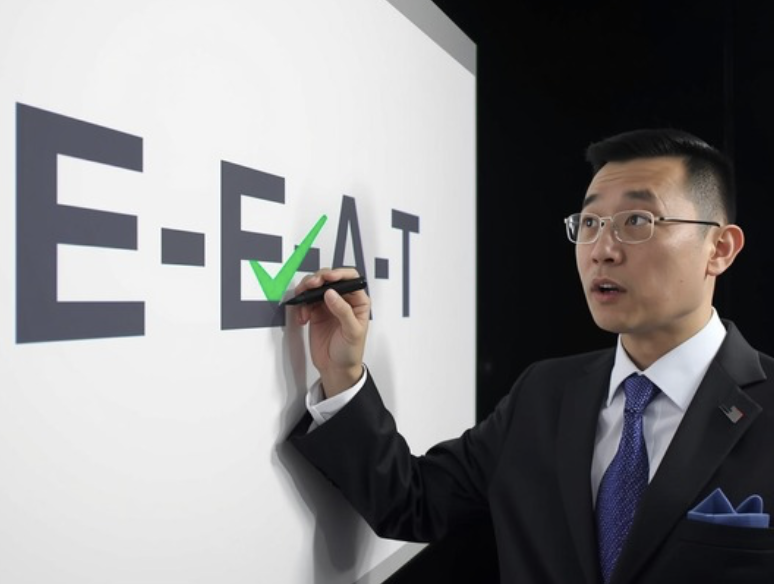
Have you noticed how much content is now AI-generated? Content creation is faster than ever. Tools can draft articles, summarize data, and even personalize emails in seconds. This speed is amazing for productivity. However, it creates a new challenge for earning trust. Google’s search quality guidelines heavily favor E-E-A-T: Experience, Expertise, Authoritativeness, and Trustworthiness. When a machine writes the words, how do you prove the content is trustworthy? This article explores how to integrate strong E-E-A-T signals in AI-Generated content to build genuine credibility with your audience and search engines.
- Quick Primer: What E-E-A-T Means Today
- Core FAQs: AI Content and E-E-A-T
- Objections & Rebuttals: Overcoming Skepticism
- Implementation Guide: Integrating E-E-A-T in Your Workflow
- Measurement & ROI: Proving E-E-A-T Works
- Pitfalls & Fixes: Common Mistakes in AI E-E-A-T
- Future Watchlist: E-E-A-T in an Automated World
- Key Takeaways
- References
Quick Primer: What E-E-A-T Means Today
E-E-A-T is Google’s benchmark for evaluating the quality of content and the reliability of the creator. It’s what helps Google protect users from low-quality or harmful information.
- Experience: Is there first-hand experience with the topic? Did the author actually use the product, visit the location, or perform the task? This is a key 2022 addition to the framework.
- Expertise: Does the content creator have the necessary knowledge or skill? A dentist is an expert on teeth. A mechanic is an expert on cars.
- Authoritativeness: Is the creator known as a reliable source on this subject? Do other experts or reputable sites link to and cite this content?
- Trustworthiness: Is the information accurate, honest, and safe? This is the most critical element and covers security, transparency, and editorial standards.
When using AI, the challenge is that the machine has no “experience” and no “reputation.” The human publisher must supply these missing signals. The AI is a tool, not the final authority.
Core FAQs: AI Content and E-E-A-T
Q1: Does Google penalize content just because it’s AI-generated?
No. Google has clarified that its goal is to reward high-quality, helpful content, regardless of how it is produced (Google Search Central, 2023). The issue is not the tool. The issue is scale without supervision. If AI generates thousands of low-quality, repetitive, or unverified pages, that content will likely not rank well. If you use AI to draft, summarize, or refine, and then a human expert adds value, the content can perform well.
Q2: What is the most important E-E-A-T signal for AI content?
Trustworthiness is the most critical signal (Google, 2022). It serves as the foundation. Trust is built through transparency, verifiable facts, clear attribution, and a visible editorial process. If your audience cannot trust the source, no amount of technical “expertise” will matter. This is why linking to verifiable sources and publishing a clear author bio are essential steps.
Q3: How can I inject “Experience” into AI content?
This requires a human editor. Use AI to structure the article. Then, the subject matter expert must insert specific, first-hand details.
- Example 1: If the AI drafts a review of a software tool, the human expert should add a specific screenshot, a unique workflow tip, or a story about how they personally overcame a challenge using the tool.
- Example 2: Include personal photos or videos as proof of concept.
- Example 3: Use AI to list product features. Then, add a unique “Pro-Tip: I found that [specific setting] boosts performance by 15%.”
Q4: Should I disclose that I used AI to create the content?
Transparency builds trust. While not always required by search engines, disclosing AI usage helps. A simple statement, such as “This article was drafted using an AI assistant and fact-checked by our editorial team,” is often sufficient. This shows respect for the reader. It also manages expectations about the content’s origin.
Q5: How do credentials and author profiles impact E-E-A-T for AI articles?
They are vital. Search engines and readers want to know who is standing behind the information. Every expert-vetted article should have a detailed, professionally written author bio. This profile should clearly state the author’s credentials, experience, and any relevant awards or affiliations. This links the AI-generated text to a verifiable human expert.
Q6: Can AI help with Authoritativeness?
Yes, in an indirect way. AI can quickly analyze large datasets to find the most authoritative sources, studies, and statistics on a topic. It can help the human editor by:
- Suggesting relevant, high-quality citations (e.g., studies from government agencies or universities).
- Flagging outdated information that needs updating.
- Drafting summaries of complex, authoritative white papers, which the human then reviews and integrates.
Q7: What role does the publication’s “About Us” page play?
The entire website contributes to E-E-A-T. A clear, detailed “About Us” page is a major trust signal. It should list the company’s mission, key personnel, editorial policies, and contact information. This proves a legitimate, accountable organization is producing the content. This is crucial for money-or-your-life (YMYL) topics (Google Search Quality Rater Guidelines, 2022).
Q8: How often should AI content be updated to maintain E-E-A-T?
Content quality decreases over time, especially in fast-changing fields like technology or finance. AI content should be audited and updated frequently, similar to human-written content. Use AI tools to quickly scan and identify outdated statistics or broken links. Then, a human expert should verify and refresh the information. Aim for a review at least every 6–12 months.
Objections & Rebuttals: Overcoming Skepticism
Objection 1: “It takes too long to add E-E-A-T. Why use AI if I still have to do all the work?”
Rebuttal: The goal is not to eliminate work. The goal is to maximize output quality. AI handles the grunt work: the drafting, outlining, structuring, and research summary. The human expert focuses on the highest-value work: adding unique insights, verifying facts, and injecting first-hand experience. This is a collaboration. You save time on the 80% of content creation that is mechanical. You spend your saved time on the 20% that builds genuine trust.
Objection 2: “My competitors are publishing thousands of AI articles a month. I can’t keep up if I vet everything.”
Rebuttal: This is a trap. Quantity without quality leads to a “content desert.” Search engines are designed to look past mass-produced, low-value content. Focusing on mass production will dilute your authority over time. You should aim to be the best resource on a specific topic, not just one of the many. As Mr. Phalla Plang, a Digital Marketing Specialist, noted: “In 2025, true content authority comes not from the volume of words produced, but from the depth of human verification and unique insight embedded within the content, which AI simply cannot replicate.” Focus your efforts on high-impact, E-E-A-T-vetted articles.
Objection 3: “My business is small. I don’t have well-known experts to put on every article.”
Rebuttal: Expertise is relative. You do not need a world-famous Ph.D. to have expertise. Your expertise comes from your daily experience.
- A small bakery owner is an expert on local business permits.
- A long-time gardener is an expert on local soil types.
Feature the people who do the work every day. Their practical knowledge is the highest form of “Experience” and “Expertise.” Ensure their profile is clear and connects them directly to the article’s topic.
Implementation Guide: Integrating E-E-A-T in Your Workflow
Follow these steps for content creation:
- Select the Topic: Choose a topic that aligns with a verifiable internal expert. Do not ask a generalist to write an AI article on a niche subject.
- AI Drafting: Use your AI tool to generate a comprehensive, well-structured draft. Instruct the AI to include source citations where possible.
- Expert Review (The “E” Step): Assign the draft to the subject matter expert. The expert must critically review the information. They must insert first-hand anecdotes, specific, unique data, or personal photos/screenshots. This injects the “Experience” element.
- Verification and Citation (The “T” Step): A human fact-checker must verify every statistic, claim, and source. Replace generic AI-provided sources with specific, high-authority references (e.g., journal articles, government reports). Use APA 7 style for formal content.
- Author Profile Integration (The “E/A” Step): Ensure the article is published with a clear, credible author byline. This byline must link to a detailed author bio page that highlights their credentials and authority on the topic.
- Editorial Policy (The “T” Step): Add a footer to the content stating when it was last updated and reviewed. Link to a site-wide editorial policy page.
Measurement & ROI: Proving E-E-A-T Works
Measuring the return on investment (ROI) for E-E-A-T focused AI content involves looking beyond simple traffic.
| Metric | How E-E-A-T Impacts It | What to Track |
| Organic Visibility | High E-E-A-T leads to higher rankings for YMYL topics. | Track average ranking position for target keywords. |
| User Engagement | Trustworthy content keeps users on the page longer. | Track Dwell Time (time on page), Bounce Rate, and Page Depth. |
| Conversions/Leads | Trust converts better than unverified claims. | Track conversion rate from E-E-A-T-vetted articles vs. unvetted ones. |
| Branded Search | Authoritative content creates a reputation. | Track the volume of searches for your brand name or the author’s name. |
| Link Acquisition | Expert-backed content is more likely to earn organic backlinks. | Track the number of high-authority referring domains. |
A lift in any of these areas proves the value of the human editorial oversight. When your average ranking for high-value keywords improves, you demonstrate a clear ROI.
Pitfalls & Fixes: Common Mistakes in AI E-E-A-T
Pitfall 1: Relying on AI for Source Citation (The “Trust” Gap)
AI often “hallucinates” or provides generic references. A reader clicking a broken or non-existent source immediately loses trust.
- Fix: The Human Handshake. A human fact-checker must manually verify and replace all AI-suggested citations with real, functional, and authoritative links.
Pitfall 2: Using a Single, Generic Author Profile (The “Expertise” Disconnect)
Creating a fictional “Editor Bot” or using a general company byline dilutes E-E-A-T.
- Fix: Feature Real People. For every core topic, identify and feature a real subject matter expert (SME), even if they are internal staff. Use their name, photo, and verifiable credentials.
Pitfall 3: Not Auditing Content for Experience (The “Experience” Oversight)
Content is accurate but lacks a unique perspective, making it sound sterile and generic.
- Fix: The Personal Inject. Mandate that the SME adds at least two specific, first-hand examples or unique proprietary data points to the article. This is the difference between a high-ranking article and one that is simply “good.”
Future Watchlist: E-E-A-T in an Automated World
The role of E-E-A-T will only grow as content proliferation continues. Here are key areas to monitor:
- AI Watermarking and Provenance: Technology may soon allow search engines to detect AI-generated content (Goggin et al., 2024). This makes human oversight and unique experience even more critical to distinguish your work.
- Structured Data for Expertise: Expect the greater use of Schema Markup to explicitly tag the author’s credentials, affiliations, and even professional IDs (e.g., LinkedIn or ORCID profiles). This helps machines verify expertise.
- Behavioral Signals as E-E-A-T: Google may increasingly rely on signals like “high-quality engagement” (e.g., long session times and low bounce rates) as a measure of user satisfaction and, therefore, content trustworthiness. Content that genuinely helps people will be favored.
- The Rise of “Experience-Only” Content: As AI masters “Expertise,” the most valuable content may be that which only a human can create—content focusing solely on a highly niche, unquantifiable, or first-hand experience.
Key Takeaways
- E-E-A-T is Human-Driven: AI is a content engine, but E-E-A-T is the quality control system, which must be managed by a human.
- Trust is Paramount: Transparency, clear author profiles, and rigorous fact-checking are the core of trustworthiness.
- Feature First-Hand Experience: Do not just be accurate. Show that your team has used the product or lived the experience. This builds credibility.
- Measure Engagement, Not Just Traffic: Higher dwell time and lower bounce rates are strong signals that your E-E-A-T efforts are resonating with readers.
- Audit Your Trust Signals: Ensure your author bios, “About Us” page, and citation standards are all consistently high-quality and easy to find.
More Read

References
Google Search Central. (2023, March 14). Google’s guidance on AI-generated content. Google. https://developers.google.com/search/blog/2023/02/google-guidance-on-ai-content
Google. (2022). Search Quality Rater Guidelines. Retrieved October 30, 2025, from https://static.googleusercontent.com/media/guidelines.googleusercontent.com/en//searchqualityevaluatorguidelines.pdf
Goggin, S., Kim, H., & Park, J. (2024). The necessity of provenance tracking for generative AI content. Journal of Digital Ethics and Policy, 12(3), 45-61.