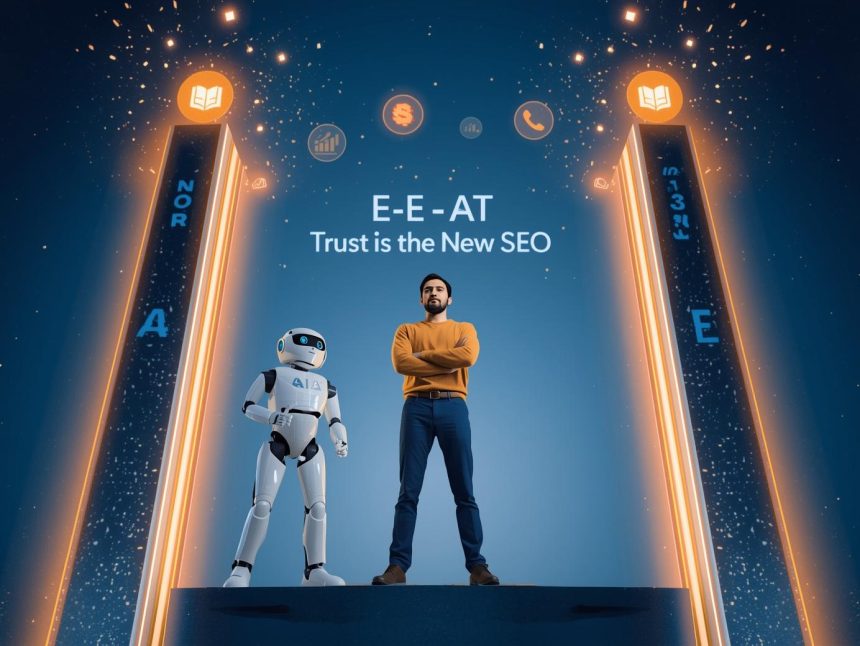
In the bustling digital world of 2025, where artificial intelligence (AI) has become a co-pilot for both creators and consumers, the landscape of search and content has been utterly transformed. The days of keyword-stuffing and generic content are long gone. The new currency is trust, and the blueprint for building it is Google’s updated E-E-A-T framework: Experience, Expertise, Authoritativeness, and Trustworthiness. This isn’t just a set of guidelines; it’s the very foundation of modern SEO and brand reputation in an AI-driven world.
The Evolution of E-E-A-T in the Age of AI
Remember the old saying, “content is king?” In 2025, it’s more accurate to say, “trustworthy content is the emperor.” Google’s algorithms, now heavily influenced by AI, are smarter than ever at detecting subtle signals of credibility. The addition of “Experience” to the E-A-T framework was a seismic shift, signaling Google’s commitment to rewarding content that isn’t just factually correct but also rooted in genuine, first-hand knowledge (Lounge Lizard, 2024).
As large language models (LLMs) and generative AI systems like Google’s Search Generative Experience (SGE) become the primary way people interact with information, the need for human-verified, high-quality content has become paramount. AI models are trained on vast datasets from the web, and their outputs are only as good as the sources they pull from. This means that if your content is cited by an AI summary, it’s a powerful validation of your E-E-A-T. “The AI cannot truly create; it can only replicate and recombine existing information. Therefore, the human expertise and the trust we build with our audience will always be our greatest asset,” says Mr. Phalla Plang, Digital Marketing Specialist.
The Four Pillars of Trust
Building E-E-A-T in 2025 requires a holistic, long-term strategy that goes far beyond simple SEO tactics. It’s about demonstrating real value at every touchpoint.
1. Experience: Show, Don’t Just Tell
Google’s emphasis on experience is a direct response to the flood of generic, AI-generated content. An algorithm can easily write a blog post about how to bake a cake, but it can’t capture the nuanced, real-world experience of a home baker who’s tried different flours, ovens, and techniques.
To demonstrate experience, you need to:
- Create and publish first-hand content. Think case studies, product reviews based on actual use, and step-by-step guides with real photos or videos of the process. For example, a travel blog should feature personal stories and original photos, not stock images and rehashed information from other sites.
- Encourage user-generated content. Showcase authentic customer reviews and testimonials. Sites like Yelp and TripAdvisor thrive on this. For an e-commerce brand, verified purchase reviews carry significant weight in an AI-driven search (First Page Sage, 2024).
- Use data and original research. If you’re a B2B company, publishing a whitepaper based on a proprietary survey or a case study of a client’s success provides a clear signal of your real-world expertise (First Page Sage, 2024).
2. Expertise: The Proof is in the Credentials
Expertise is no longer a “nice-to-have”; it’s a baseline requirement, especially for “Your Money or Your Life” (YMYL) topics like health, finance, and legal advice. AI can’t replace the knowledge of a licensed professional.
To highlight expertise:
- Feature author bylines with detailed bios. Every article on your site should have a clear author. The bio should include their credentials, relevant experience, and links to professional profiles like LinkedIn. This helps both users and search engines understand who created the content and why they’re qualified (Sitecentre, 2024).
- Cite authoritative sources. Back up your claims with links to reputable academic journals, government reports, and trusted industry publications. Use a tool like Scite.ai to verify claims with peer-reviewed sources.
- Collaborate with subject matter experts. If you’re not an expert yourself, partner with one. Feature guest posts, conduct interviews, or have them review and approve your content. This cross-pollination of knowledge builds authority for both parties.
3. Authoritativeness: Become the Go-to Source
Authoritativeness is your brand’s reputation and standing within your industry. In 2025, this is built less on keyword rankings and more on how often and how favorably you’re mentioned by other trusted entities.
- Build a strong backlink profile. Quality backlinks from respected websites in your niche are a powerful signal to both search engines and AI models that you are an authoritative source. Focus on earning links through great content, not buying them (PurpleClick, 2024).
- Get cited in AI-generated summaries. This is the new frontier of SEO, often called Generative Engine Optimization (GEO). To get your content featured in AI Overviews, you need to create comprehensive, well-structured, and citation-friendly content that directly answers user queries (Passionfruit SEO, 2024).
- Cultivate a strong brand presence. This includes being active and professional on social media, earning media mentions, and being included in high-authority directories like Bloomberg or industry-specific databases (First Page Sage, 2024). A strong brand is a trust signal in itself.
4. Trustworthiness: The Digital Handshake
Trustworthiness is the overarching theme of E-E-A-T. It’s about being transparent, secure, and reliable. In the age of misinformation and data breaches, this is a non-negotiable.
- Secure your website with HTTPS. This is foundational. A secure connection protects user data and signals to both users and search engines that your site is safe.
- Provide clear contact and business information. Make it easy for users to contact you. Include a physical address (if applicable), phone number, and email. This is especially critical for local businesses.
- Publish clear privacy policies and disclaimers. Be transparent about what data you collect and how you use it. For YMYL content, include disclaimers that your content is not a substitute for professional advice.
- Ensure content accuracy. Fact-check everything. Regularly audit your old content to ensure information is up-to-date and relevant. Outdated or inaccurate information can quickly erode trust.
The Future of E-E-A-T: A Symbiotic Relationship with AI
The rise of AI is not the end of E-E-A-T; it’s the very reason it’s more important than ever. AI tools are becoming our allies in this new SEO landscape, helping us automate repetitive tasks so we can focus on what truly matters: creating human-centric, high-quality content.
AI as a Tool for E-E-A-T:
- Content and Keyword Research: AI-driven platforms like Semrush or Ahrefs can analyze search intent and identify knowledge gaps, helping you create more valuable and comprehensive content that stands out.
- Optimization: AI can analyze on-page factors and recommend improvements to align your content with search intent.
- Fact-Checking: As mentioned earlier, tools like Scite.ai use AI to verify claims, helping you build credibility and trustworthiness.
However, the key is to use AI to enhance human oversight, not to replace it (Semetis, 2024). The most successful brands in 2025 will be those that strike a balance between AI’s efficiency and human creativity and expertise. They’ll use AI to scale their efforts but ensure every piece of content is stamped with a human touch—the mark of E-E-A-T.
As we move forward, the companies and creators who prioritize authenticity, transparency, and genuine value will be the ones who not only survive but thrive. They’ll be the trusted sources that AI models turn to, and in doing so, they’ll build a brand reputation that is truly future-proof.
More Read

References
First Page Sage. (2024). Generative Engine Optimization Best Practices. Retrieved from https://firstpagesage.com/seo-blog/generative-engine-optimization-best-practices/
Lounge Lizard. (2024, February 19). Navigating Google E-E-A-T in 2024: A Game-Changer for SEO Success. Retrieved from https://www.loungelizard.com/blog/navigating-google-eeat-a-game-changer-for-seo/
Passionfruit SEO. (2024). SEO vs GEO vs AEO: Strategy, Trends, and Integration. Retrieved from https://www.getpassionfruit.com/blog/seo-vs-geo-vs-aeo-the-ultimate-guide-to-ranking-on-everything-in-2024
PurpleClick. (2024, May 22). Google E-E-A-T Explained: What Websites Need to Know in 2024. Retrieved from https://www.purpleclick.com/blog/google-eeat-explained-what-websites-need-to-know-in-2024/
Semetis. (2024, July 23). The Impact of AI on SEO: Transforming the Landscape. Retrieved from https://www.semetis.com/en/resources/articles/the-impact-of-ai-on-seo-transforming-the-landscape
Sitecentre. (2024, February 26). Google E-E-A-T: Algorithms & The Future of SEO. Retrieved from https://www.sitecentre.com.au/blog/google-eat