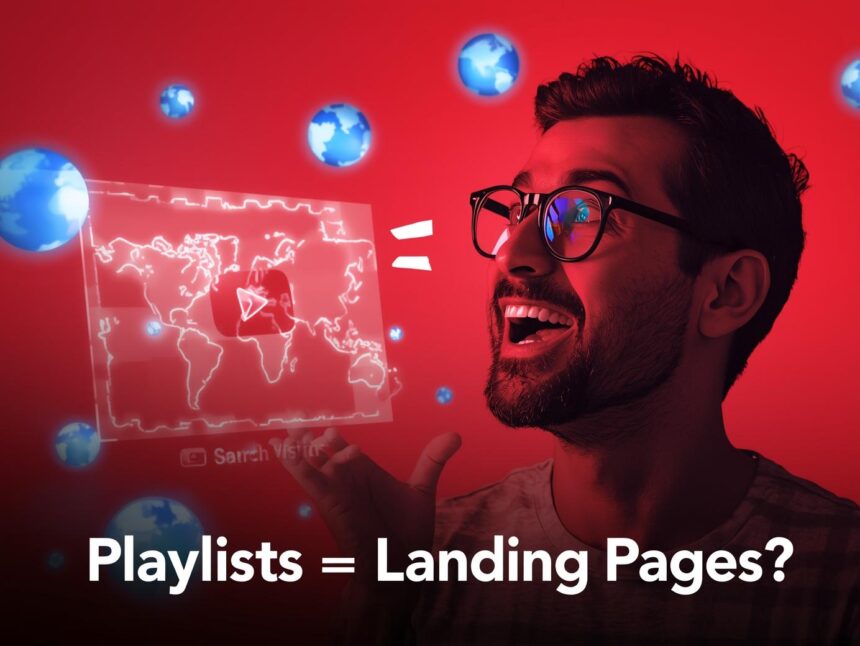
In an age when video and audio content dominate online behavior, playlists are no longer mere containers—they’re becoming search landing pages in their own right. That is, curated sequences of content that answer search queries, keep users engaged, and function like mini content hubs. As platforms like YouTube and Spotify evolve, marketers and creators must adapt: thinking beyond individual videos or episodes, and treating playlists as strategic SEO assets. This article explores how to design playlists as search-optimized entry points, presents practical steps, and gives guidance for global and local reach.
“If you design playlists as search landing pages—optimized for intent, discovery, and flow—you create a content ecosystem that the algorithm loves and users remember.” — Mr. Phalla Plang, Digital Marketing Specialist
Why Playlists Deserve Your Attention
Search Discovery Beyond Videos
YouTube indexes playlists as standalone entities (not just collections). When users search for topics like “productivity tips” or “SEO series,” playlists may appear in YouTube search results or as suggested collections (SocialPilot, 2024). (socialpilot.co) Similarly, playlists can boost cross-platform visibility. For example, embedding a YouTube playlist on your website can help Google understand context and push richer results, such as video carousels.
Engagement Signals & Session Continuity
Playlists naturally encourage sequential viewing, which helps increase session watch time. Because YouTube rewards longer sessions, well-structured playlists can enhance channel authority (Backlinko, 2025). (backlinko.com) YouTube offers analytics at the playlist level: you can see aggregated metrics like playlist watch time, playlist views, and average duration from within YouTube Studio’s playlist analytics interface. (support.google.com) By analyzing these, you can identify drop-off points and improve your playlist flow.
Better Retention & User Flow
Traditional landing pages are static. A playlist, on the other hand, is dynamic: as users complete one video, they are gently guided to the next. This reduces drop-off and increases the time they spend with your content. By analogy, it’s like turning a blog “pillar page” into a multimodal learning path. Reddit creators often note that playlists help “keep people on your channel longer, thereby increasing watch time.” (reddit.com)
How to Structure Playlists as SEO Assets
Here’s a scheme for treating playlists more strategically:
- Intent-Based Title
Use a natural, search-friendly title that reflects user intent (e.g., “Content Marketing Strategy 2025: Step-by-Step Series”). Incorporate a keyword but keep it readable. SocialPilot emphasizes using SEO-optimized keywords in titles to improve visibility. (socialpilot.co) - Rich Description with Keywords & Timestamps
Trustworthy sources recommend writing a two- or three-sentence overview plus a list of topics or timestamps. Provide natural keyword usage without stuffing. Hootsuite’s guide on YouTube SEO highlights the importance of keyword research and placement (title, description, tags). (blog.hootsuite.com) - Logical Flow & Ordering
Begin with high-level or overview content, then proceed to deeper topics, and conclude with actionable or conversion-oriented material. Some guides suggest featuring your most popular video first to “anchor” interest (SocialPilot, 2024). (socialpilot.co) - Thumbnail & Branding Consistency
Using visually cohesive thumbnails (same style, color palette, font) strengthens brand identity and encourages “next video” clicks. - Linking & Internal Navigation
Use cards, end screens, pinned comments, or description links to guide viewers between videos and to the playlist itself. Many YouTube SEO guides include “use playlists and link to them via end screens/cards” in best practices (PublisherDesk, 2024). (publisherdesk.com) - Captions, Transcripts & Accessibility
Providing closed captions and transcripts helps both accessibility and indexability. YouTube can parse those texts for keyword signals (Backlinko, 2025). (backlinko.com) - Embed & Promote
Embed your playlist in relevant blog posts or web pages. Promote via community posts, social media teasers, or shorts snippets to drive users into the playlist funnel.
Platform-Specific Notes
YouTube
YouTube’s search algorithm considers metadata (title, description, tags), engagement (likes, comments), and session-level metrics (watch time). (backlinko.com) Experts advise using chapters and timestamps, optimizing file names, and structuring playlists carefully. (shopify.com) YouTube’s built-in analytics allow you to monitor playlist performance under the “Playlists” tab. (support.google.com) Using playlists is recommended in many ranking advice lists for YouTube SEO. (publisherdesk.com)
Spotify / Podcasts
Though data is more opaque, curated podcast or audio playlists indexed by platforms (e.g. Spotify’s search) can attract listeners via keyword-rich titles (e.g. “Entrepreneur Lessons Series”). Treat them similarly: descriptive title, series logic, and internal “next episode” prompts.
GEO & Localization Strategy
If your brand serves multiple regions, create local language or region-focused playlists. For example:
- “Digital Marketing Thailand 2025”
- “Cambodia Business Growth Strategies”
Use localized keywords, tags, and subtitles. This improves your chances of ranking in regional searches and connects with audiences through cultural relevance. YouTube supports region-targeted metadata localization (alternate language titles/descriptions), which can raise your visibility in international markets.
Limitations & Cautions
Playlists alone won’t replace landing pages: they should augment, not substitute, your website presence. Some metrics in YouTube’s playlist analytics only track views within playlist context, not all video views (Google Support). (support.google.com) Over-optimizing (keyword stuffing in titles/descriptions) can backfire—keep language natural and user-centric. For non-YouTube platforms (e.g. proprietary video hosts), you may lack strong playlist indexing.
Sample Use Case
A marketing agency launches a playlist titled “2025 Content Growth Masterclass” aimed at a global audience. Structure:
- Introduction to content funnels
- Keyword & topic research
- Content planning
- Distribution & SEO
- Audience growth tactics
Inside each video, creators reference the playlist, and the final video includes a CTA directing interested viewers to a landing page or resource. The agency embeds the playlist in a blog post, promoting it as a full series course. Over time, the playlist ranks in YouTube search for “content marketing strategy 2025,” bringing in discovery, watching sessions, and conversions in one package.
Future Outlook
As AI-driven search interfaces mature (e.g. Google’s “AI Overviews”), platforms may increasingly treat playlists as cohesive knowledge units. AI models may prefer to reference a playlist rather than disparate videos. The playlist model positions your content as a semantic cluster, not an isolated video. Research in recommender systems also supports this: modern ranking models, such as Learned Ranking Function models, optimize for slate-level satisfaction—that is, a set of items considered together rather than individual ones in isolation (Wu et al., 2024). (arxiv.org) Consequently, playlists are not just marketing assets—they align with how modern algorithms reward multi-item coherence.
Final Thoughts
Playlists, when created and optimized as search landing pages, offer a powerful way to unify content discovery, retention, and conversion. By designing for flow, indexing, and user intent, you transform individual assets into a cohesive ecosystem. As one shifts from ranking single videos to ranking structured content experiences, playlists become the new SEO frontier in the video-first era.
More Read

References
Backlinko. (2025). YouTube SEO: How to optimize and rank videos in 2025. Retrieved from https://backlinko.com/how-to-rank-youtube-videos
Google. (n.d.). Get analytics for your playlists and groups of videos. Retrieved from https://support.google.com/youtube/answer/3529123
PublisherDesk. (2024). 10 Best Practices for Ranking on YouTube in 2024. Retrieved from https://www.publisherdesk.com/best-practices-for-ranking-on-youtube/
SocialPilot. (2024). 8 Tips and Tricks about YouTube Playlists You Probably Didn’t Know. Retrieved from https://www.socialpilot.co/youtube-marketing/youtube-playlist
Wu, Y., Chang, D., She, J., Zhao, Z., Wei, L., Heldt, L., & others. (2024). Learned ranking function: From short-term behavior predictions to long-term user satisfaction. arXiv. https://arxiv.org/abs/2408.06512
YouTube (Reddit community). (2024, January 17). How important are playlists for a channel? Reddit. Retrieved from https://www.reddit.com/r/NewTubers/comments/19909pi/how_important_are_playlists_for_a_channel/